
Most of the titanium that leaves our shop is EDC hardware, and knife scales are the part that generates the most questions before the order and the most arguments after it. Which grade. How tight the holes really need to be. Why the stone-wash on the sample looked different from the stone-wash on the batch. This is the answer we give customers, written down once.
Grade 5 or Grade 2?
Almost every production scale we machine is Grade 5 (Ti-6Al-4V, Chinese designation TC4). It is an alloy, roughly two and a half times the strength of commercially pure titanium, and that strength is what you feel in a scale: the threads for the clip and standoff screws hold up to repeated disassembly, thin sections around the pivot do not deform, and a 3 mm scale feels like a 3 mm scale rather than a sheet.
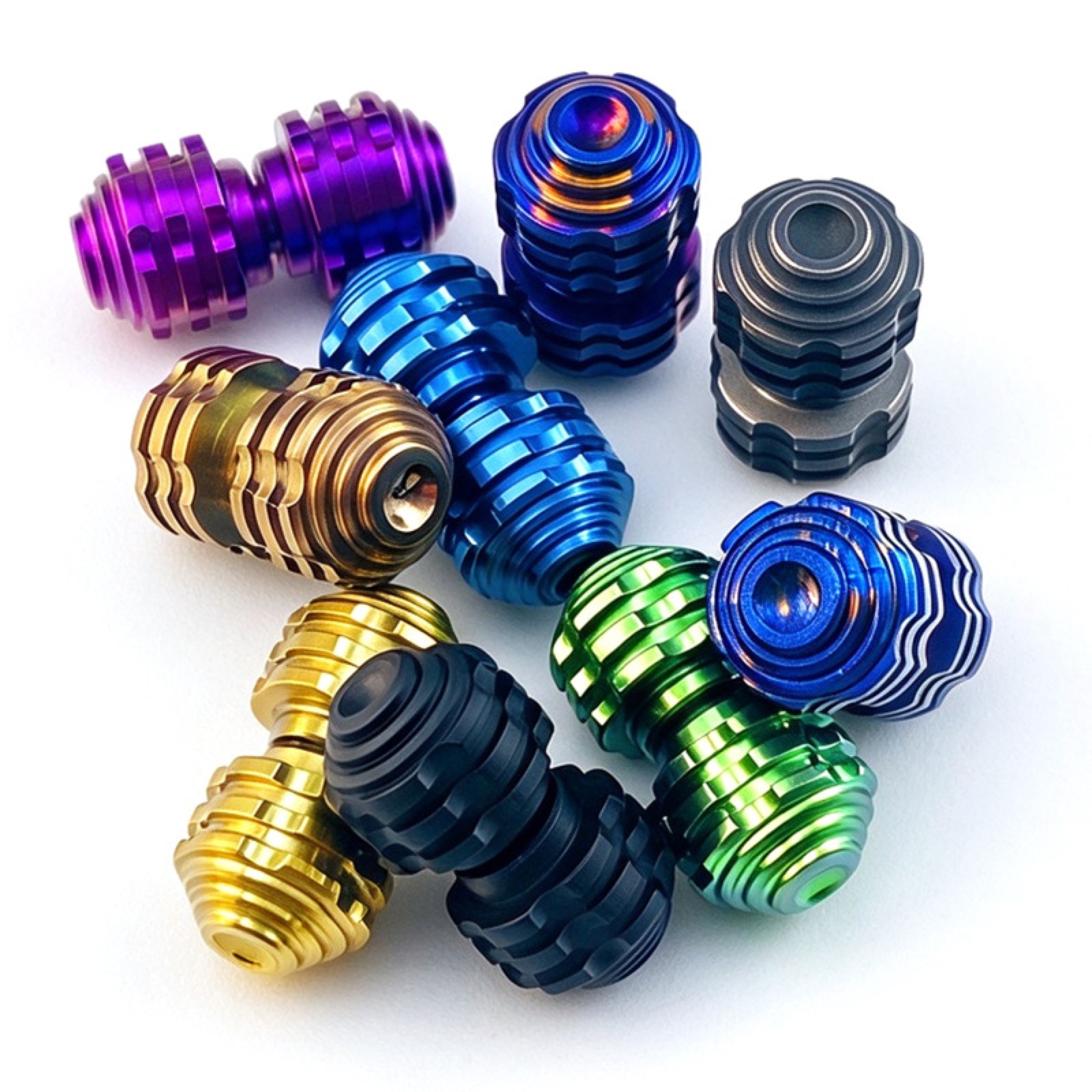
Grade 2 (commercially pure, TA2) is softer and more ductile. It machines and polishes more easily, anodises a touch brighter and more evenly, and is the better choice for pieces where strength is not the point: beads, pendants, inlays, decorative bolsters, parts that will be hand-finished heavily. On a working scale it is usually the wrong choice, because the first stripped standoff thread costs more than the material ever saved.
| Property | Grade 5 · Ti-6Al-4V · TC4 | Grade 2 · CP titanium · TA2 |
|---|---|---|
| Tensile strength (min, ASTM B265) | 895 MPa | 345 MPa |
| Feel in a 3–4 mm scale | Stiff, hard, holds threads | Noticeably softer, threads wear |
| Machining | Slower, runs hot, needs the right cutters | Easier, gummy rather than hard |
| Anodising | Full colour range, tones slightly muted | Full colour range, brighter and more even |
| Typical use | Scales, frame locks, liners, clips, standoffs | Beads, inlays, bolsters, jewellery-type parts |
We keep TA1, TA2 and TC4 in stock, plus titanium damascus for scale work, so a titanium job does not wait on a material purchase. If your drawing says “Ti-6Al-4V” and nothing else, we will quote Grade 5 annealed plate and say so on the quote.
The tolerances that matter on a scale, and the ones that do not
A scale drawing often arrives with ±0.02 mm written in the title block and applied to everything, including the outside contour and the chamfers. That makes the part more expensive without making the knife any better. On titanium we hold ±0.01 mm where it is called for; the point is to call for it in the right places.
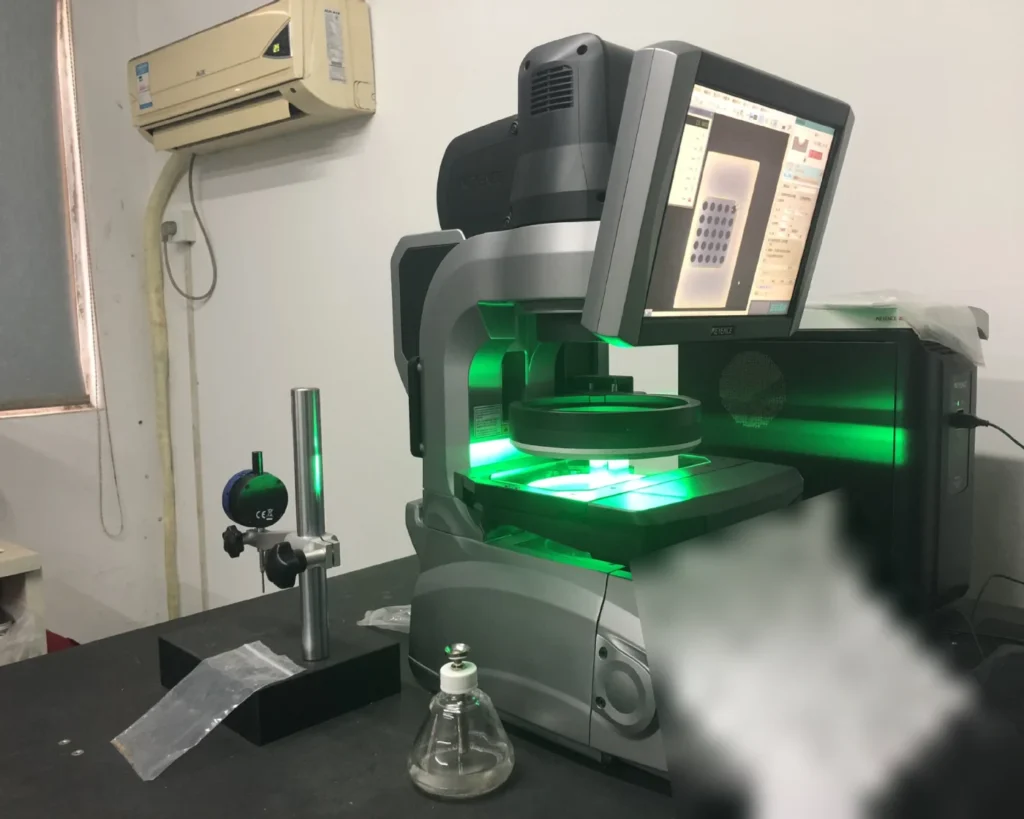
- Pivot bore and pivot counterbore. This is the dimension that decides whether the knife centres and how the action feels. Mark it critical, with the fit you want against your pivot.
- Standoff and clip hole pattern. Position matters more than diameter. A pattern that is 0.05 mm out across a 90 mm scale will still assemble; one that is out on one hole will not.
- Liner pocket depth and flatness. If the scale sits on a liner, the pocket depth sets the lock-bar clearance. We machine both scales of a pair in the same setup so the pair matches.
- Thickness. Usually only one face is a reference. Say which, and whether the thickness is before or after finishing: a stone-wash removes a measurable amount from a sharp edge and almost nothing from a flat face.
- Outside contour, chamfers, jimping. ±0.1 mm general tolerance is fine here and nobody will ever measure it. Spend the tolerance where the knife feels it.
Threads in titanium deserve one line of their own. Titanium galls, so a small thread cut with a worn or uncoated tap either tears or comes out tight. Call out the thread class you need: a 2-56 or M2.5 thread in a scale is the feature the customer will use most and the one that fails loudest, so it is the one we check first on the first piece.
Finishes that work on titanium scales
Titanium takes four finishes well. Each one hides some things and shows others, and the one thing none of them hides is a tool mark. We wrote a separate piece on that: why titanium scales show tool marks and how to stop them. The short version is that the surface going into finishing has to be right already; finishing decides how the part looks, not whether it was machined properly.
| Finish | What it looks like | What it hides | What it does not hide | Notes |
|---|---|---|---|---|
| Stone-wash | Grey, matte, fine random scratches | Handling marks, light scratches over the knife’s life | Stepover banding, deep tool marks | Blast first, then 1–2 h in the tumbler. The most forgiving finish to own. |
| Bead blast | Uniform satin matte | Fine machining texture | Oils and fingerprints show more than on stone-wash | 80–120 grit, then fine media. Usual base under anodising. |
| Hand satin | Directional grain | Little; it is honest | Any cross-scratch | 240 → 400 → 600 progression by hand. Labour-priced. |
| Mirror polish | Bright, reflective | Nothing | Everything, including the next fingerprint | Smoothing passes, then polishing, final stage by hand. Titanium heats up in the hand, so it is slow and priced accordingly. |
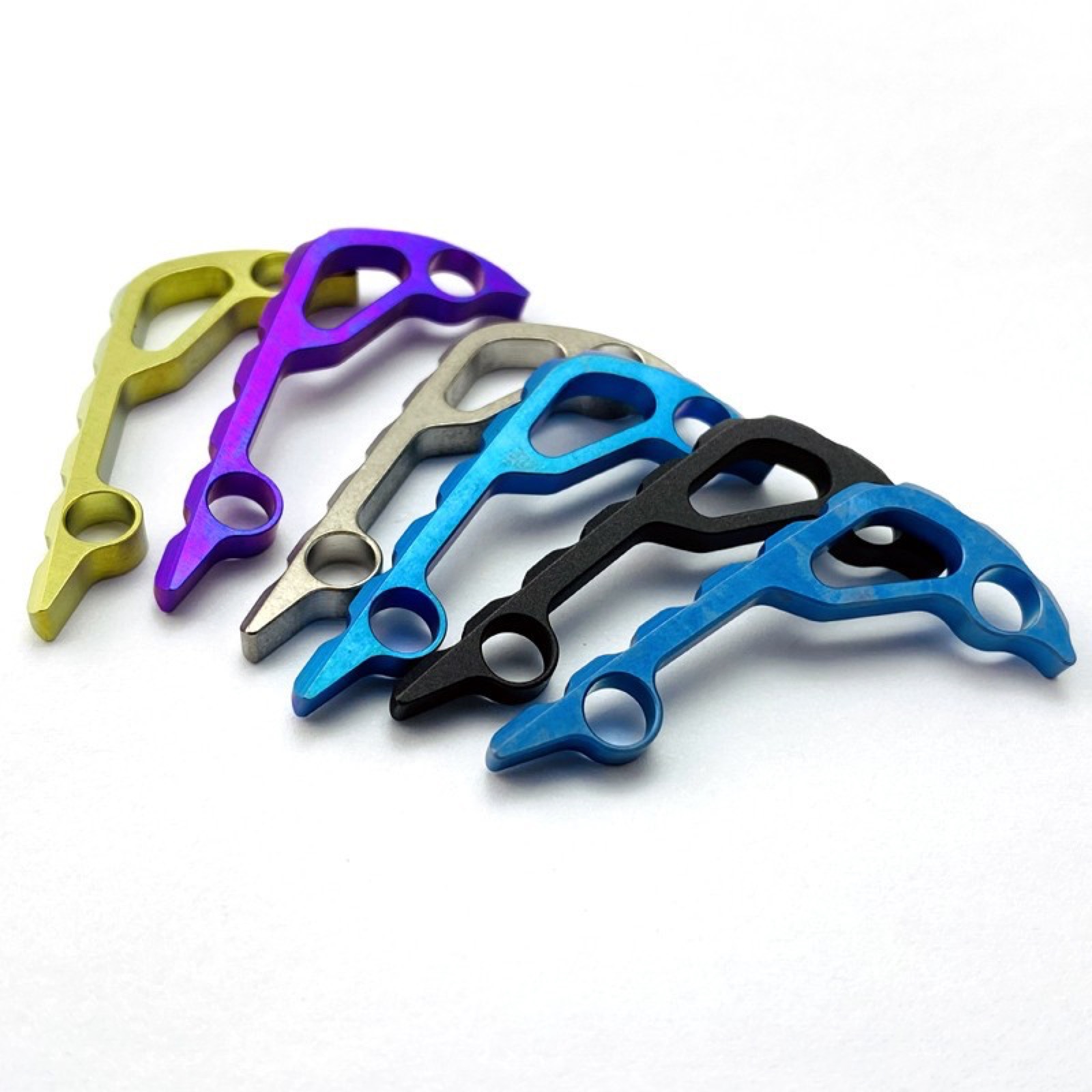
| Anodising | Colour: blue, purple, bronze, gold, green, depending on voltage | Nothing; it is an oxide layer a fraction of a micron thick | Scratches show bare metal underneath | Applied over any of the above. Anodise, then tumble, gives the worn two-tone look some brands ask for. |
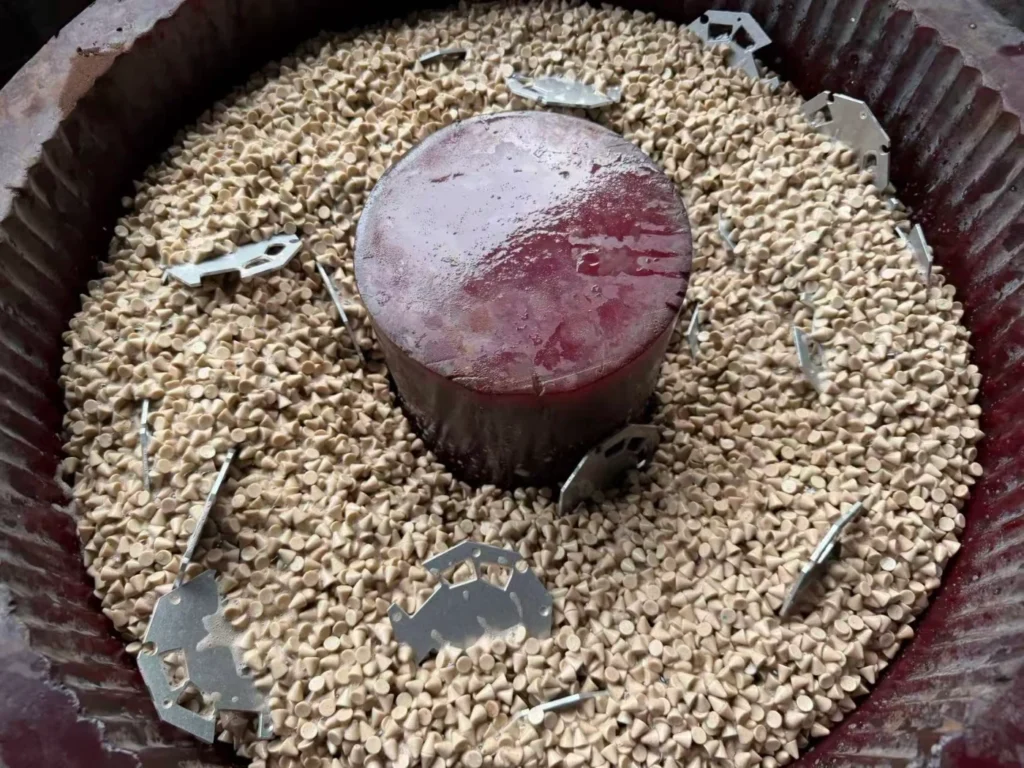
Two practical notes. First, specify the finish with a reference photo or a sample, not a word: “stone-washed” covers everything from a light tumble to an hour with ceramic cones, and the two look nothing alike. Second, decide the finish before the first article. We machine to the finish; a part that will be stone-washed is programmed differently from one that will be hand-satined.
Why customers choose stone-wash
Stone-wash is the finish most customers choose for an outdoor knife. The tumbling media removes the burr from the edges, softens the sharp machined corners and leaves a matte surface that hides handling marks. The result is a smoother feel in the hand and a more rugged, used look — not a showroom polish.
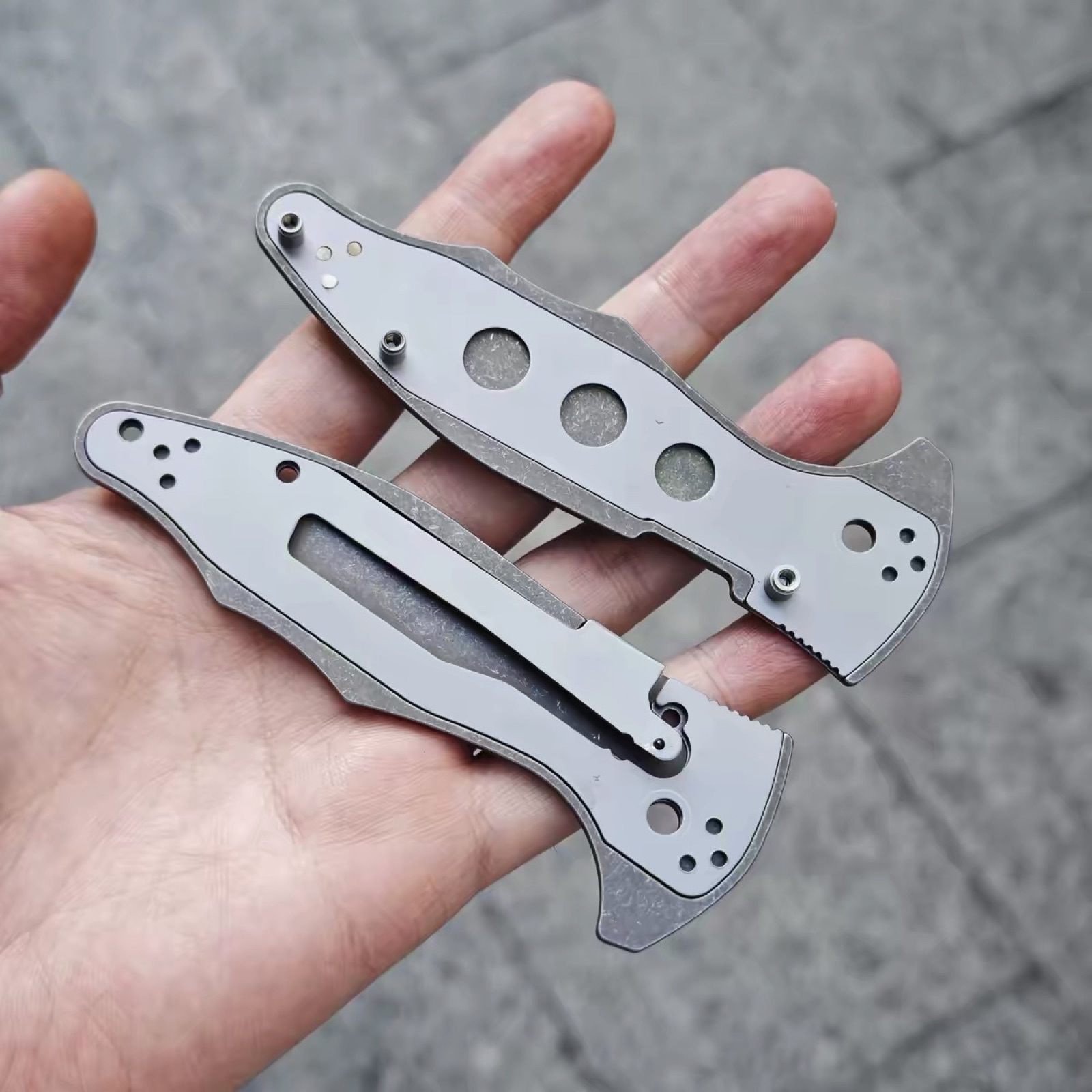
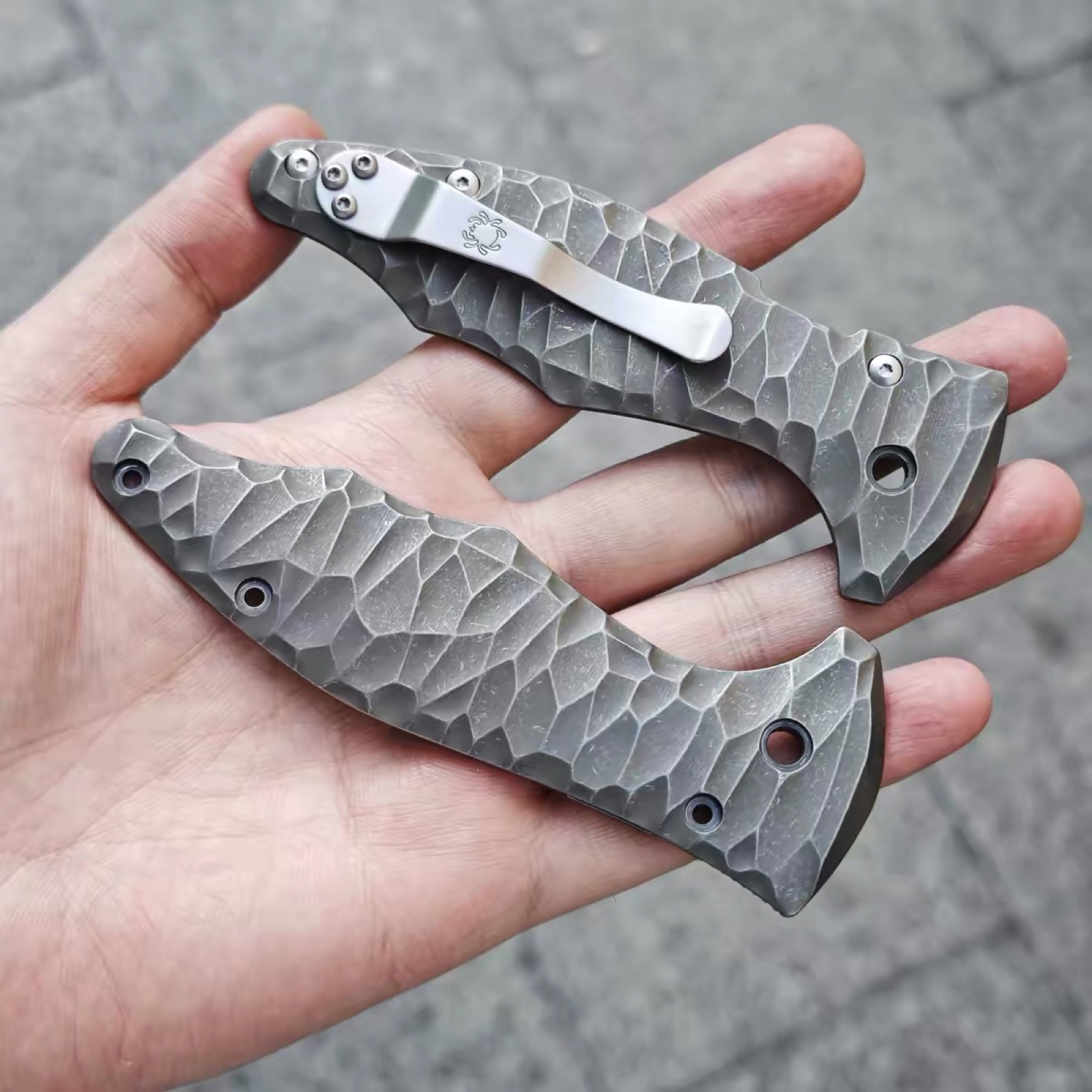
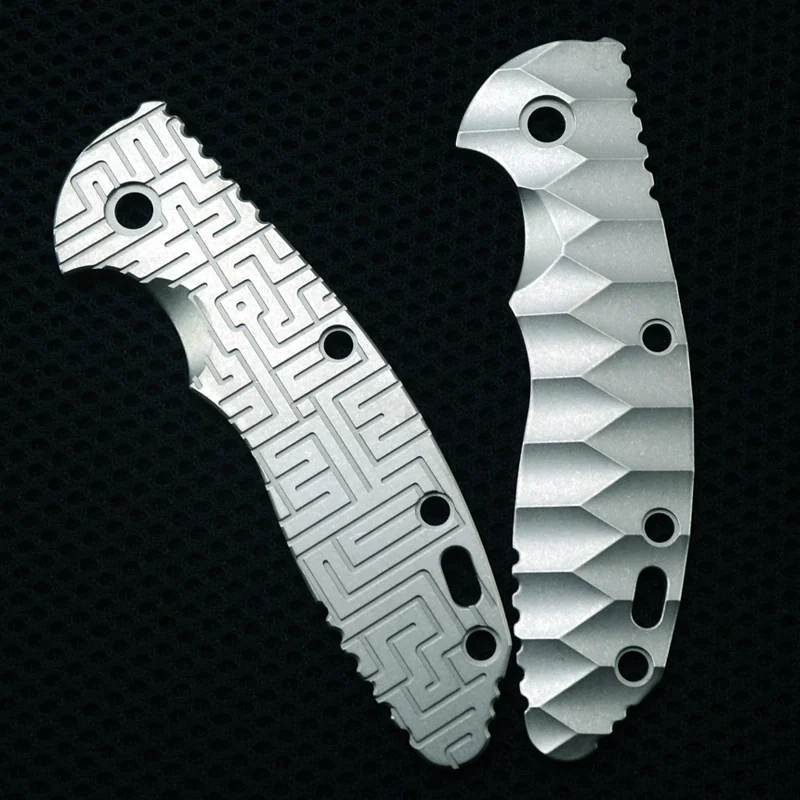
Two versions are common: a plain stone-wash on a machined handle, and a carved or textured handle that is stone-washed after machining. The texture is cut first; the tumble only softens it. Neither hides a deep tool mark — the cut still has to be right.
- Removes burrs and softens sharp edges.
- Hides handling marks and light scratches.
- Matte, rugged look that suits outdoor knives.
- Smoother in the hand than a polished surface.
- Does not hide deep tool marks or stepover banding.
Stone-wash rounds edges. If the design needs a crisp edge or a sharp spine, mask it or choose a different finish.
What a titanium scale job looks like from our side
We have machined titanium for twelve years and it is about a fifth of what we export. The batches run from one piece to ten thousand, which in practice means a maker ordering a prototype pair and a brand ordering a production run get the same programming attention, because the first pair is what the production run is copied from. The parts of a scale we are strongest on are the ones that go wrong elsewhere: thin walls around the pivot, deep standoff holes, contoured and irregular outer shapes, and the surface finish on the show face.
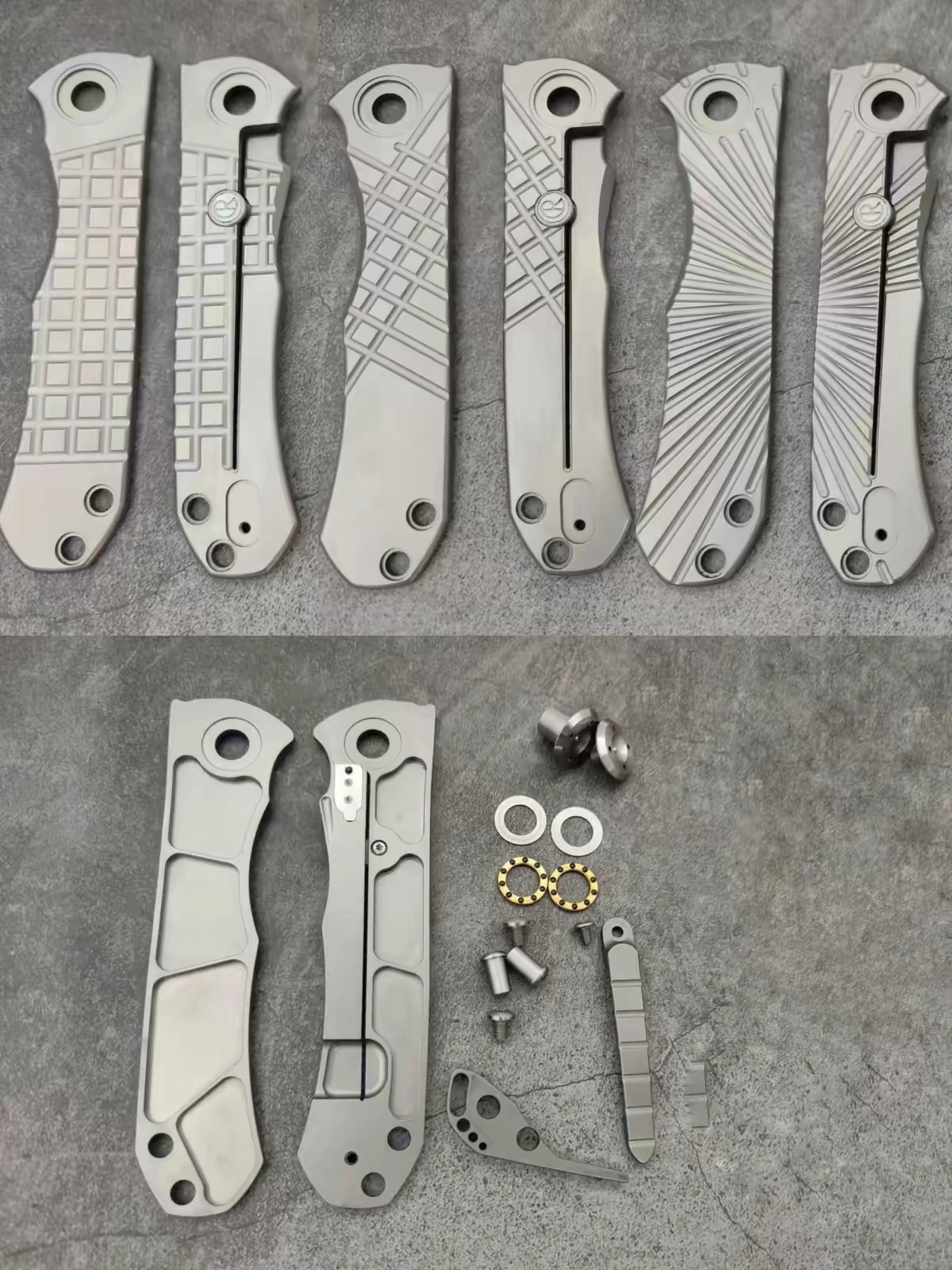
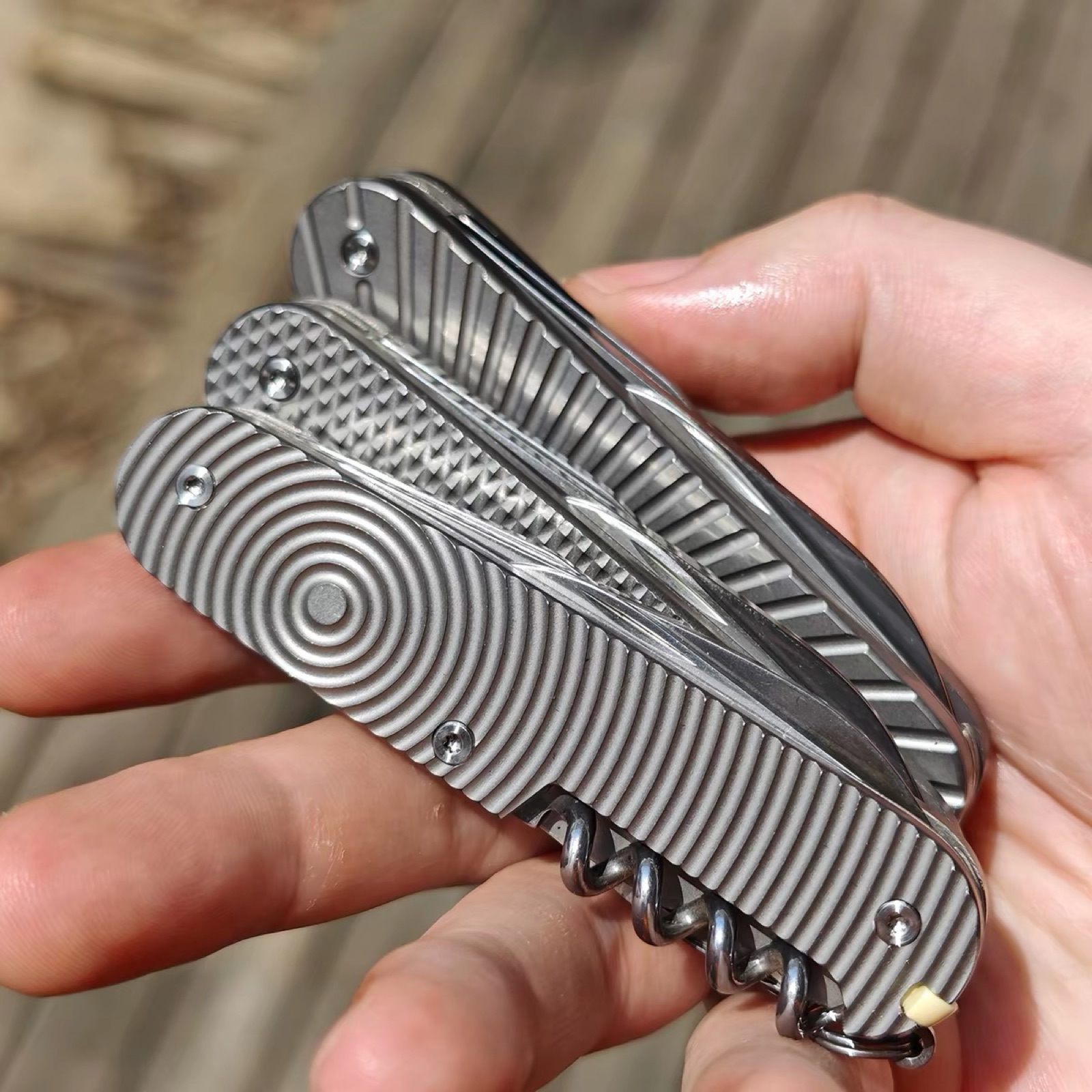
The handles above show the pattern range we machine — plain, grid, diagonal and radial — before the final stone-wash or anodise.
Stone-washing is done in house on our own machines. Anodising goes to the finishing partner we have used for years; we manage it, inspect the parts when they come back, and you deal with one supplier.
What to send for a quote
- A STEP file and a 2D drawing, with the pivot bore, hole pattern and any pocket depth marked as critical. Everything else can carry the general tolerance.
- Grade, if you have a preference. If not, we quote Grade 5 and say so.
- The finish, with a reference photo, and whether anodising is wanted on top.
- Quantity for the first order and the likely annual quantity, because the fixture we build for ten pairs is not the one we build for a thousand.
Quotes go back within 16 hours, and if we think a feature on the drawing will cost you money without adding anything to the knife, the quote will say that too.
We machine titanium, stainless, aluminium and brass in Dongguan, China — 3- and 4-axis milling, turning and EDM. If you are drawing a titanium scale, clip or frame, send the drawing for a free DFM review or request a quote, and we will tell you which dimensions we would mark critical and which finish we would steer you towards.
A scale that failed, and what we changed
An 800-set order of Grade 5 titanium scales, two models, for a knife brand we had supplied for five years. The first scales came off the machine with visible tool marks. The drawing called for a stone-wash; we ran the parts for five hours, which normally evens out the surface. It did not hide the marks. The batch was at risk.
The cause was the cutter strategy, not the finishing. A single cutter had been used for roughing and finishing, and it was worn by the time it reached the final pass. Titanium work-hardens and conducts heat poorly, so a worn cutter rubs instead of shearing; the mark is pressed into the surface. Stone-washing rounds edges and blends the surface, but it cannot remove a mark that is deeper than the finish allowance.
We changed three things: a separate, sharp cutter for the finish pass; a lower surface speed with coolant directed at the cut; and a workholding change that supported the thin section around the pivot. The first scale from the revised process was inspected under the agreed light before the batch continued. The marks were gone, and the stone-wash produced the even finish the customer expected.
The lesson was not “polish harder”. It was “fix the cut before the finish”. A finishing operation can hide a good surface; it cannot rescue a bad one. The customer stayed, but the batch cost us more than the margin on the order — which is why the first piece is now checked before the run, not after.
Bottom line
Titanium scales are decided by the cutter, the workholding and the finish sequence, not by the grade alone. Use Grade 5 for working scales, keep a separate finish cutter, support thin sections, and approve the finish on a physical sample. A stone-wash is a finish, not a repair. Send the pair drawing and the finish reference; we will tell you where the marks are likely to come from.
Common titanium-scale mistakes
- Grade 2 for a working scale. It is softer; threads wear and thin sections deform. Grade 5 is the default for a scale that is used.
- ±0.02 on the outside contour. The pivot and the hole pattern matter; the contour and chamfers usually do not. Spend the tolerance where the knife feels it.
- The wrong thread class. Titanium galls. A worn or uncoated tap tears the thread; specify the class and check the first piece.
- Approving a finish from a photo. Stone-wash, brush and anodise all read differently under different light. Approve a physical sample.
- Using the stone-wash to hide tool marks. It rounds edges; it does not remove a mark deeper than the finish allowance.
Before you order scales
- Grade 2 or Grade 5, and why.
- Pivot bore and counterbore fit.
- Standoff and clip hole pattern.
- Thread class and hardware.
- Finish sample and anodising voltage.
- First quantity and annual volume.
A knife-scale inspection plan
A scale is judged by the pivot, the hole pattern, the thickness, the contour and the finish. Inspect the features that decide the action and the fit; do not spend time on the outline if the pivot is wrong.
| Feature | Check | Instrument |
|---|---|---|
| Pivot bore | Diameter and position | Pin gauge / CMM |
| Pivot counterbore | Depth and concentricity | CMM / depth gauge |
| Standoff/clip pattern | Position | CMM |
| Thickness | Before/after finishing | Micrometer |
| Contour | Profile to the drawing | CMM / profile projector |
| Finish | Stone-wash/brush/anodise | Sample comparison |
| Pair | Left/right match | Pair inspection |
The first piece should be checked against the approved sample under the agreed light. For a pair, inspect both scales against each other, not just against the drawing.
Titanium scale order checklist
- Grade, pivot fit and hole pattern.
- Thickness before/after finishing.
- Thread class and hardware.
- Finish sample and anodising voltage.
- Pair matching requirement.
- Quantity and first-article approval.
FAQ
Should I use Grade 5 or Grade 2 titanium for knife scales?
Grade 5 (Ti-6Al-4V) for working scales: it holds threads, resists deformation in thin sections and wears better. Grade 2 is softer and finishes more easily, so it suits beads, inlays and decorative parts where strength is not the point.
What tolerance matters most on a scale?
The pivot bore and counterbore, and the standoff/clip hole pattern. The outside contour and chamfers usually do not need better than ±0.1 mm.
Why does the stone-wash look different between batches?
Stone-wash removes material from edges, not flat faces. Media size, time, part orientation and the starting surface all change the result. Approve a physical sample, and keep the process parameters with the order.
Can you anodise titanium scales?
Yes, in the full voltage colour range. Colour depends on surface finish and voltage, so the finish must be agreed before anodising. We send a coupon for approval on cosmetic parts.
What is your minimum quantity?
No MOQ. The fixture and programme are priced for the quantity you order; a ten-pair order will have a higher per-part cost than a thousand-pair order, and the quote will show it.

Related reading
- Titanium CNC machining service
- Why titanium knife scales show tool marks
- Case study: 800 titanium knife scale sets
- CNC machining tolerance chart
- Anodized Titanium Colors: What Actually Repeats (and What Doesn’t)
- Custom G10 Knife Handles: From First Sample to Production
- CNC machining services
- Pure titanium chains: types, benefits and applications