
Rapid CNC prototyping, from one part to a pilot run.
Send a STEP file before noon and get a quote within 16 hours. First parts typically ship in 5–10 working days — machined, measured and finished, not printed.
- ±0.002 mm on critical features
- CMM first-article report
- 32 machining centres, 19 four-axis
- No MOQ — one part is an order
- 16-hour quotes
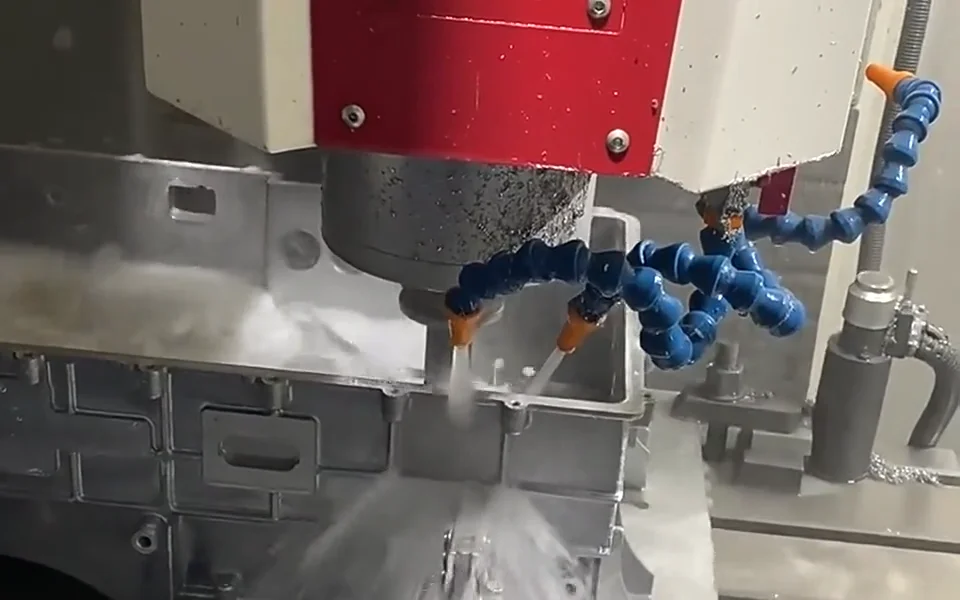
What we prototype
Enclosures and housings
Milled shells, lids, bezels and mounting features in aluminum, stainless or engineering plastic. Threads, pockets and cable exits cut in one setup where possible.
Brackets, mounts and fixtures
Load-bearing brackets, sensor mounts, test fixtures and assembly jigs. We quote the material and the finish as one finished part.
Manifolds and fluid parts
Air and fluid manifolds, valve bodies and pump components. We check bore alignment and seal faces on the CMM before the part ships.
Knife and EDC components
Scales, liners, spacers, clips and hardware in titanium, G10, carbon fibre and stainless. See the knife and EDC page for finishes.
Replacement and reverse-engineered parts
A broken part, a caliper and no drawing. We measure, model and machine a replacement, then send the drawing with the part.
Pilot-run tooling
Bridge tooling, nest fixtures and low-volume production aids for a line that is not ready for hard tooling.
Machined prototype vs 3D printed part
| CNC machined prototype | 3D printed prototype | |
|---|---|---|
| Material | The production alloy or plastic | A proxy material, often not the final one |
| Tolerance | ±0.002 mm on critical features | Typically ±0.1–0.3 mm, worse on thin walls |
| Surface | Ra 0.4–3.2 µm; can be anodised or polished | Layer lines; limited finishing |
| Threads and inserts | Cut or tapped, load-bearing | Usually post-installed, weaker |
| Best use | Fit, function, drop and leak tests | Form studies and early ergonomics |
If your prototype has to pass a test rather than a meeting, machine it.
Materials and finishes
We machine the same materials we run in production: aluminum 6061-T6, 7075-T6 and 2024; stainless 303, 304, 316L and 17-4 PH; titanium Grade 2 and Grade 5; brass, copper; PEEK, POM, ABS, PC, PTFE and G10. Finishing — anodising, bead blasting, polishing, passivation, plating and laser marking — is quoted as one finished part, one invoice.
Aluminum CNC machining · Titanium CNC machining · PEEK machining · All materials · Surface finishes
How the 5–10 day timeline works
Day 0 — quote and DFM
Send STEP plus drawing. We return price, lead time and a short DFM note within 16 hours, usually the same working day.
Day 1 — material and setup
Material is released and the first setup is built. If a tolerance needs a different strategy, we call before cutting.
Day 2–7 — machining
Milling, turning or EDM, depending on the part. Complex parts may need two or three setups; that is planned into the date.
Day 6–9 — finishing
Anodising, plating, polishing or blasting through long-term partners, managed on our invoice.
Day 7–10 — inspection and ship
First article measured on the CMM, report as PDF, then packed and shipped DDP or FOB.
DFM notes that save a week
- Deep pockets with square corners. A smaller corner radius or a relieved pocket often removes a second EDM operation.
- Tolerances on non-functional faces. Marking ±0.05 mm everywhere adds cost without adding function. Mark the critical few.
- Thin walls. Below 1 mm in aluminum, we plan support and lighter cuts; tell us early so the finish does not suffer.
- Surface finish callouts. Ra 0.8 on a cosmetic face is a different route than Ra 3.2. Send a sample if the look matters.
FAQ
How fast is a CNC prototype?
Typically 5–10 working days after drawing approval, depending on material, tolerance and finish. A simple aluminum part can ship in 5 working days; a titanium part with finishing usually takes 7–10. We confirm the date in the quote, not after you pay.
Can you make one part?
Yes. One piece is a valid order. There is no minimum order quantity, and no setup fee hidden in a separate line.
What files do you need?
A STEP or IGES file and a 2D drawing with tolerances, threads and surface finish. If you only have a PDF or a sketch, send it — we will tell you what is missing before quoting.
Is CNC prototyping more expensive than 3D printing?
For one simple part, sometimes yes. For a part that must hold tolerance, take a thread, or survive a drop test, CNC is usually cheaper than printing, inspecting, and printing again. We will say so if printing is the better route.
Do you offer design-for-manufacturing feedback?
Yes. Every quote includes a short DFM note on the features that drive cost or risk. We mark the callouts, suggest changes, and you decide.
Can the prototype and production run use the same fixture?
Yes. The fixture and program stay with the part. That is why the 500th part matches the first one instead of drifting.
Do you sign an NDA?
Yes, yours or ours. Files are seen only by the engineer who quotes them and the programmer who runs them.
Send one part. Get a real prototype quote in 16 hours.
Upload a STEP file and drawing. We reply with price, lead time and a DFM note — no commitment, no minimum order.