
PEEK machining for parts that cannot afford to move.
Natural, black, GF30 and CF30 PEEK, machined with the annealing and inspection plan the material needs. ±0.02 mm routine, material certificates, 5–10 day prototypes.
- Natural, black, GF30, CF30
- Annealing and stress relief
- ±0.02 mm routine
- Material certificates
- No MOQ, 16-hour quotes
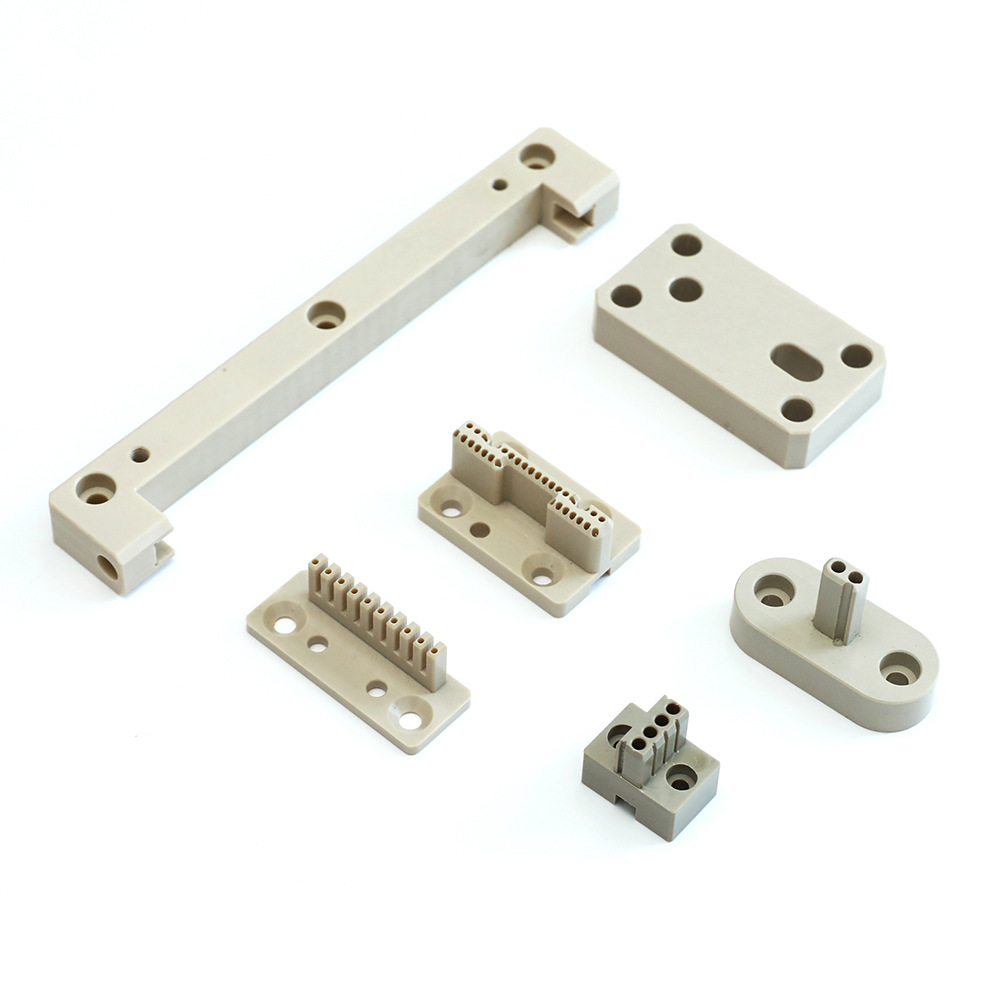
What we machine in PEEK
Seals, rings and wear parts
Back-up rings, seal seats, wear pads and bushings where metal would gall or corrode.
Insulators and electrical parts
Standoffs, insulators, terminal blocks and high-voltage components.
Manifolds and fluid components
Low-volume manifolds, valve bodies and pump parts for chemical and food processing.
Medical-adjacent parts
Trays, fixtures, instrument housings and non-implant components. No ISO 13485 claim.
Semiconductor and vacuum parts
Clean, low-outgassing components machined without contaminated tooling.
Prototype and replacement parts
One part or a pilot run, including reverse-engineered parts from a sample.
PEEK grades and what they change
| Grade | What it adds | Typical use |
|---|---|---|
| Natural PEEK | Unfilled, highest purity | Seals, insulators, food and medical-adjacent parts |
| Black PEEK | Pigmented, similar mechanical properties | Visible parts, light-sensitive applications |
| PEEK GF30 | 30% glass fibre: stiffer, lower expansion | Structural parts, wear components |
| PEEK CF30 | 30% carbon fibre: stiffest, highest strength | High-load wear parts, precision structures |
| Medical-grade PEEK | Documented grade and certificate | Medical-adjacent parts, subject to your regulatory review |
Fillers change machinability and edge quality. Tell us the grade before we quote; the same drawing in GF30 can cost more than natural PEEK.
Why PEEK is harder than it looks
- Heat. PEEK conducts heat poorly, so the cutter stays hot and the part can soften or smear. We use sharp tools, lower surface speed and coolant directed at the cut.
- Movement after machining. Residual stress makes PEEK move over hours or days. Annealing before finishing, and sometimes before the finish pass, keeps the final tolerance.
- Contamination. PEEK picks up chips and oils. Parts for clean applications are machined on cleaned machines with dedicated fixtures.
- Measurement. PEEK expands with temperature and absorbs moisture. We state the measurement condition so the CMM number means something.
Finishing and inspection
PEEK is usually supplied as-machined, bead blasted or annealed. There is no anodising or plating. We deburr by hand, clean the part, and measure critical features on the CMM. Material certificates and batch numbers are supplied with the inspection report. If your application needs a cleanliness standard, tell us before quoting — cleaning and packaging are quoted separately.
PEEK material data · Quality and inspection · Free DFM review
FAQ
Which PEEK grades do you machine?
Natural, black, glass-filled (GF30) and carbon-filled (CF30) PEEK, plus Victrex and similar medical-grade stocks when the certificate is required. Send the grade and we will confirm stock.
Do you anneal PEEK after machining?
Yes, when the part geometry or tolerance calls for it. Annealing relieves the stress that makes PEEK move after machining; we quote it as part of the process, not as an extra.
What tolerance can you hold in PEEK?
±0.02 mm on critical features is routine; ±0.01 mm is possible on small, rigid parts. PEEK moves with temperature and moisture, so we state the measurement temperature and the condition of the part.
Can you make food-contact or medical parts?
We machine the geometry and supply material certificates. We do not hold ISO 13485, and we do not certify biocompatibility or food contact — that is the material supplier’s and your regulatory team’s call.
Why is PEEK more expensive than aluminum?
The material costs far more, and it is slower to machine because heat builds up and the part moves. The quote separates material and machining so you can see both.
Do you machine PEEK prototypes?
Yes — one part is a valid order, usually 5–10 working days after drawing approval.
Can you bond or assemble PEEK parts?
Simple press-fit and screw assembly, yes. Structural bonding and welding are quoted case by case through a partner.
Send a PEEK part. Get a real quote in 16 hours.
Upload a STEP file and drawing, tell us the grade and the measurement condition, and we will reply with price, lead time and a DFM note.