
CNC Machining HDPE
High-density polyethylene is the cheap, tough, chemically inert plastic that shrugs off acids, water and impact and never absorbs moisture. It is the material of bottling-line star wheels, wear strips, tank fittings and food-contact parts. The trade-off is softness: HDPE moves under the clamp and under heat, so a good HDPE part is designed around what the material will not do.

Grades and forms
Most HDPE we machine is PE 300 sheet or rod in natural or black. Ask for a grade only when the application needs one.
| Form / grade | Best for | Notes |
|---|---|---|
| HDPE natural (PE 300) | Food-contact parts, cutting boards, general machining | FDA-compliant grades available; white/natural shows dirt, machines cleanly |
| HDPE black, UV-stabilised | Outdoor and marine parts | Carbon black stops UV embrittlement; the choice for anything left in sunlight |
| PE 500 (HMW-PE) | Wear strips, chain guides with more abrasion | Higher molecular weight, better wear than PE 300, still easy to machine |
| PE 1000 (UHMW-PE) | Heavy wear, impact, sliding parts | A different material in practice — far better wear, tougher to machine. See polyethylene |
| Sheet / rod / tube | Sheet for plates and guides, rod for turned parts | Sheet up to 100 mm thick is routine; large plates arrive with internal stress and need a skim cut both sides first |
Soft, gummy, and it moves if you let it
HDPE cuts easily with sharp, high-rake tooling and plenty of chip clearance. The material is gummy rather than brittle: a dull cutter smears instead of cutting, leaving a fuzzy edge and a burr that has to be removed by hand. We run it dry or with air, at high speed and a positive feed, and we keep the tools sharp.
The difficulty is holding it. HDPE is soft enough to deform under vise pressure, so a part clamped hard, machined flat and released will spring back out of flat. Thin plates are held on vacuum or with light, distributed clamping. Thermal expansion is roughly ten times that of steel, which is why a dimension measured at the machine and again in an air-conditioned inspection room can differ.
Tolerances follow from that. ±0.1 mm is comfortable on most features; tighter is possible on small dimensions when the part is stress-relieved and measured at a stated temperature, but it costs machine time and should be called out only where it matters.
| At a glance | |
|---|---|
| Service temperature | Around 80 °C continuous |
| Chemical resistance | Excellent — acids, alkalis, alcohols, water; attacked by strong oxidisers |
| Moisture absorption | Practically none; dimensions do not drift with humidity |
| Weakness | Soft, high thermal expansion, poor UV resistance unless black; almost impossible to glue or paint |
| Typical parts | Star wheels, guide rails, wear strips, tank fittings, cutting boards, spacers, food-contact parts |
CNC machined HDPE parts
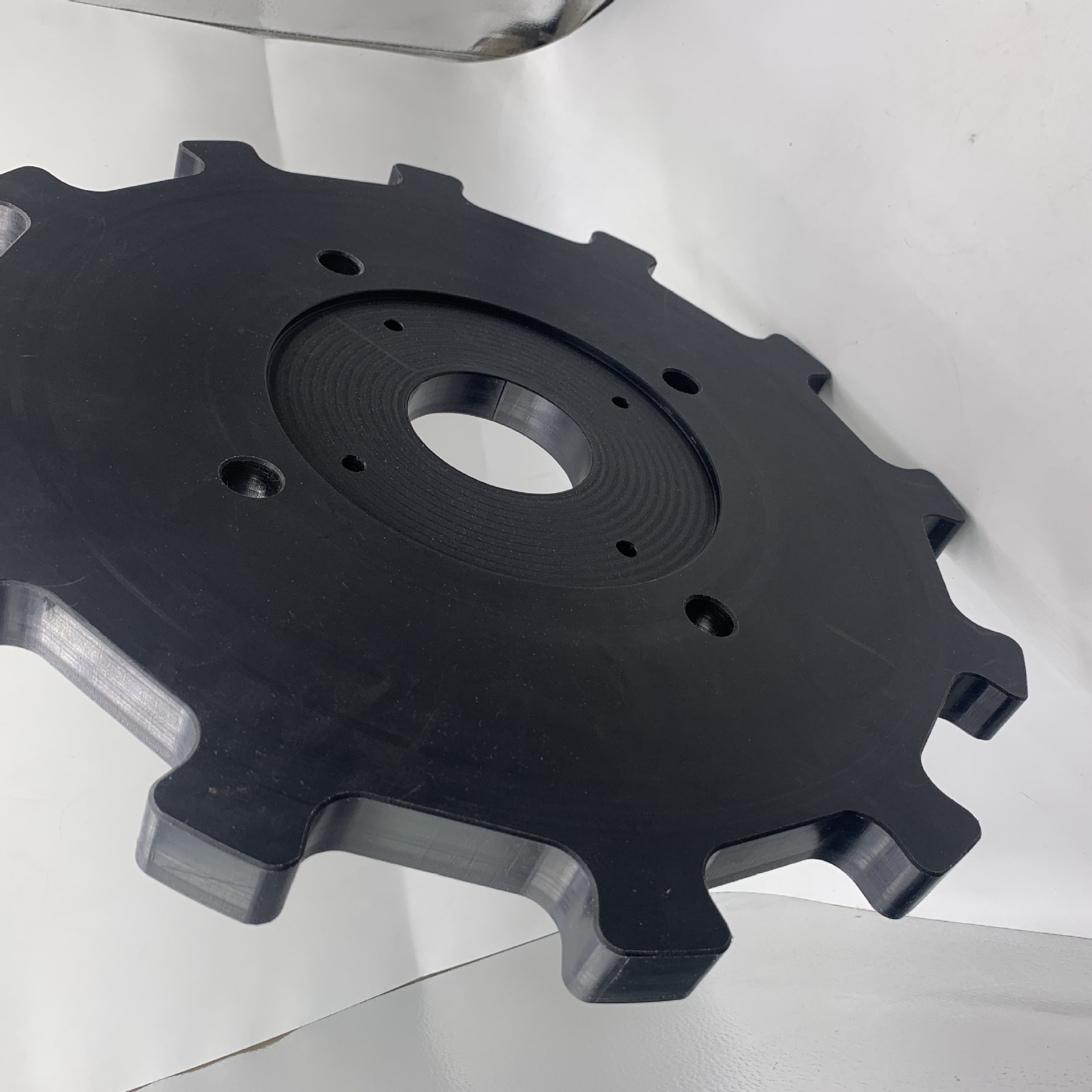
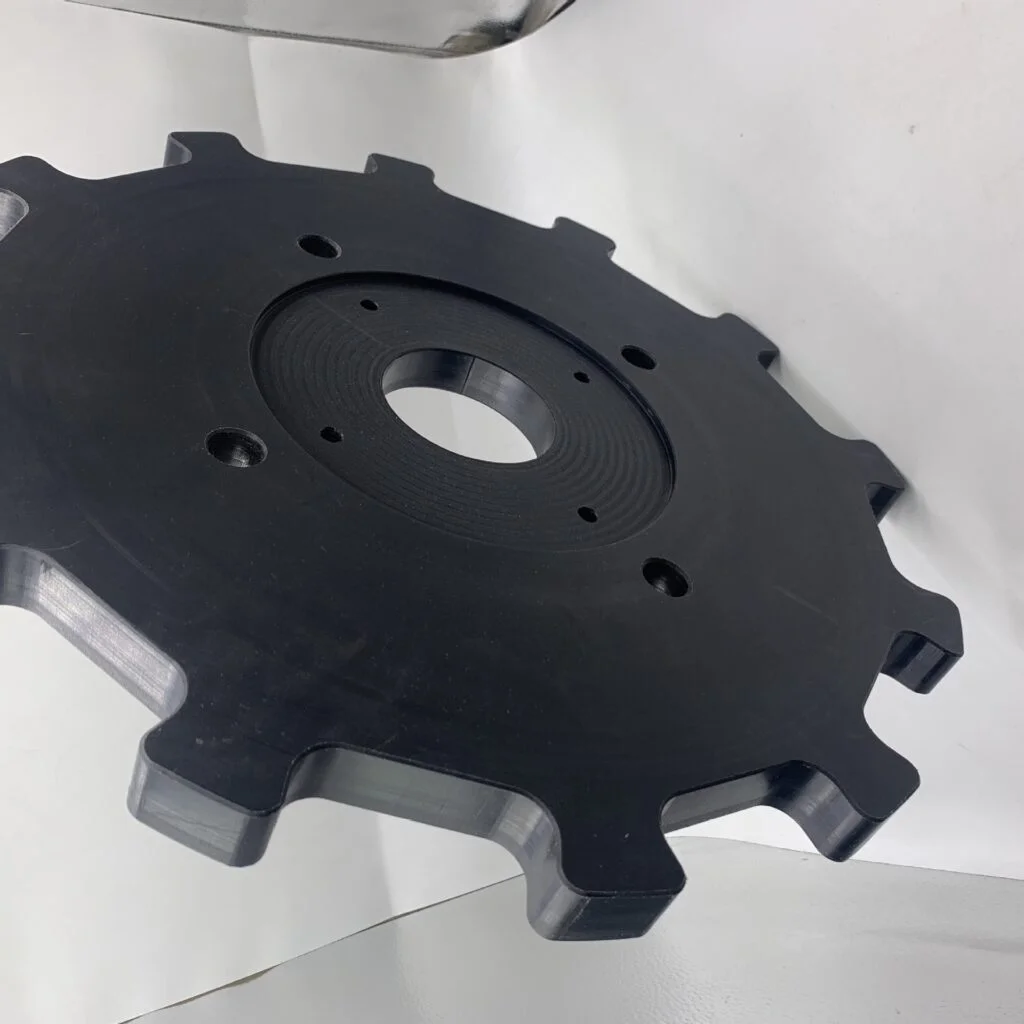
Star wheels, guide rails, wear strips, tank fittings, spacers and food-contact parts — cut from HDPE sheet and plate. It moves with temperature more than most plastics, so measured size and installed size are not the same number.
Four rules for an HDPE part that stays in tolerance
Keep tolerances honest
Ask for ±0.1 mm where the part allows it and tight tolerances only on the features that mate. Every tight dimension on HDPE is a stress-relief cycle and a temperature-controlled measurement.
Design for mechanical fastening
HDPE cannot be reliably glued or painted. Use screws, inserts, snap features or a dovetail. Press-fits relax over time; if a press-fit is unavoidable, tell us so we can size it.
Leave wall and floor thickness
Thin floors and long thin walls warp as internal stress releases. 3 mm is a sensible minimum for a machined wall; thicker if the part sees heat.
Say if it is food, water or chemical contact
HDPE is used for all three, but the grade and the paperwork are not the same. Tell us what the part touches and we will quote stock that matches, not just HDPE.
Ready for a quote?
Send the drawing — price and lead time within 16 hours. STEP, IGES, X_T, DWG, DXF or PDF.
No minimum order.