
CNC Machining for Robotics and Automation
Joint housings, gearbox flanges, encoder mounts, end effectors and mounting plates — usually aluminium, usually needed sooner than the schedule allows. Quotes in 16 hours, no minimum order.
Problems buyers bring us in this sector
Robotics work is iterative and impatient. These are the three problems that come up most, and how we keep them from slowing you down.
“Revision three is due before revision two has arrived”
Quote in 16 hours. We keep programs and setups per part number, so a revision of a part we have already made sits at the fast end of the 7–15 day window. Give us the previous part number in the RFQ and we will find the file.
“The bearing bore is loose — or the bearing will not go in”
Tell us the fit class, not just the nominal. We work ISO 286 IT6–IT7 on bearing bores and check them with a gauge as well as on the CMM, because a bore that measures right and feels wrong is still wrong.
“Bores on two faces do not line up”
On a four-axis setup the part is not re-clamped between faces, so we hold about 0.01 mm between them. If the geometry forces two setups, you hear about it in the quote, not on the first article.
What we machine for robotics customers
Robotics work is iterative: a part gets made, tested, changed and made again. We quote fast and we keep your programs, so revision two is quicker and cheaper than revision one.
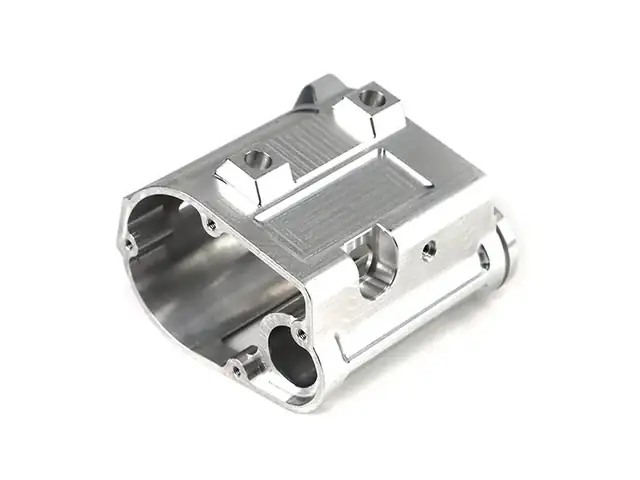
Joint and actuator housings
Milled 6061 and 7075 housings with bearing bores held to an interference or transition fit.
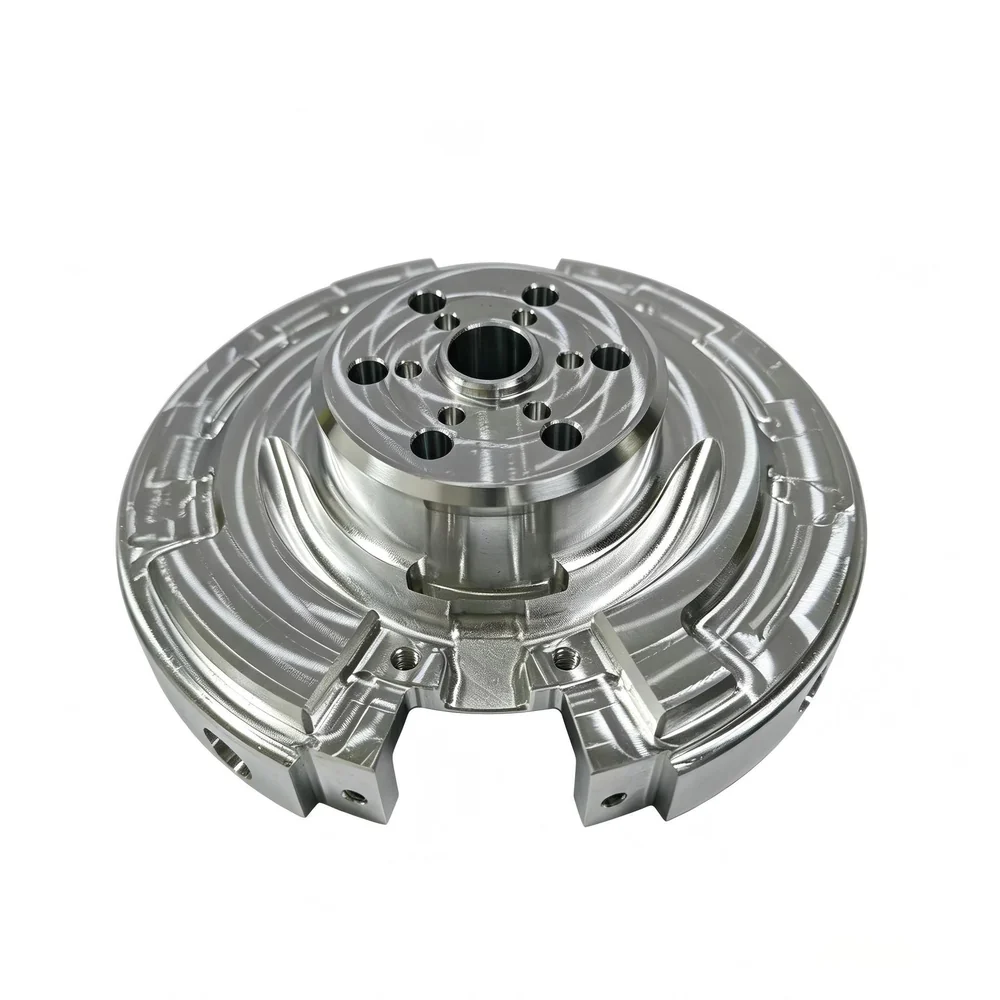
Gearbox and motor flanges
Turned and milled flanges with pilot diameters and bolt circles in true position.
Encoder and sensor mounts
Small precision mounts where concentricity to the shaft decides whether the encoder reads true.
End effectors and grippers
Custom jaws, fingers, vacuum plates and tool adapters in aluminium and engineering plastics.
Structural plates and brackets
Mounting plates, links and arms milled from plate, anodised or bead blasted.
Cable and harness hardware
Strain reliefs, clamps and guides — small parts nobody wants to wait three weeks for.
What these parts are usually made from
6061 for most structure, 7075 where stiffness or strength decides it, POM and nylon where weight or noise does.
What we watch on a robotics drawing
Bearing fits, concentricity and weight
Almost every robotics part we make comes down to a bearing bore and the features around it. Nineteen of our 32 machining centres are four-axis, so a housing with bores on more than one face can stay in a single setup and hold true position between them.
- Bearing bore fitsISO 286 IT6 – IT7
- Concentricity, one setup0.01 mm achievable
- Achievable, milled±0.002 mm on critical features
- Four-axis centres19 of 32
- Typical quantity1 – 500
- Unmarked dimensionsISO 2768-mK
Motor swing arms and joint links for gimbals, drones and small robot arms
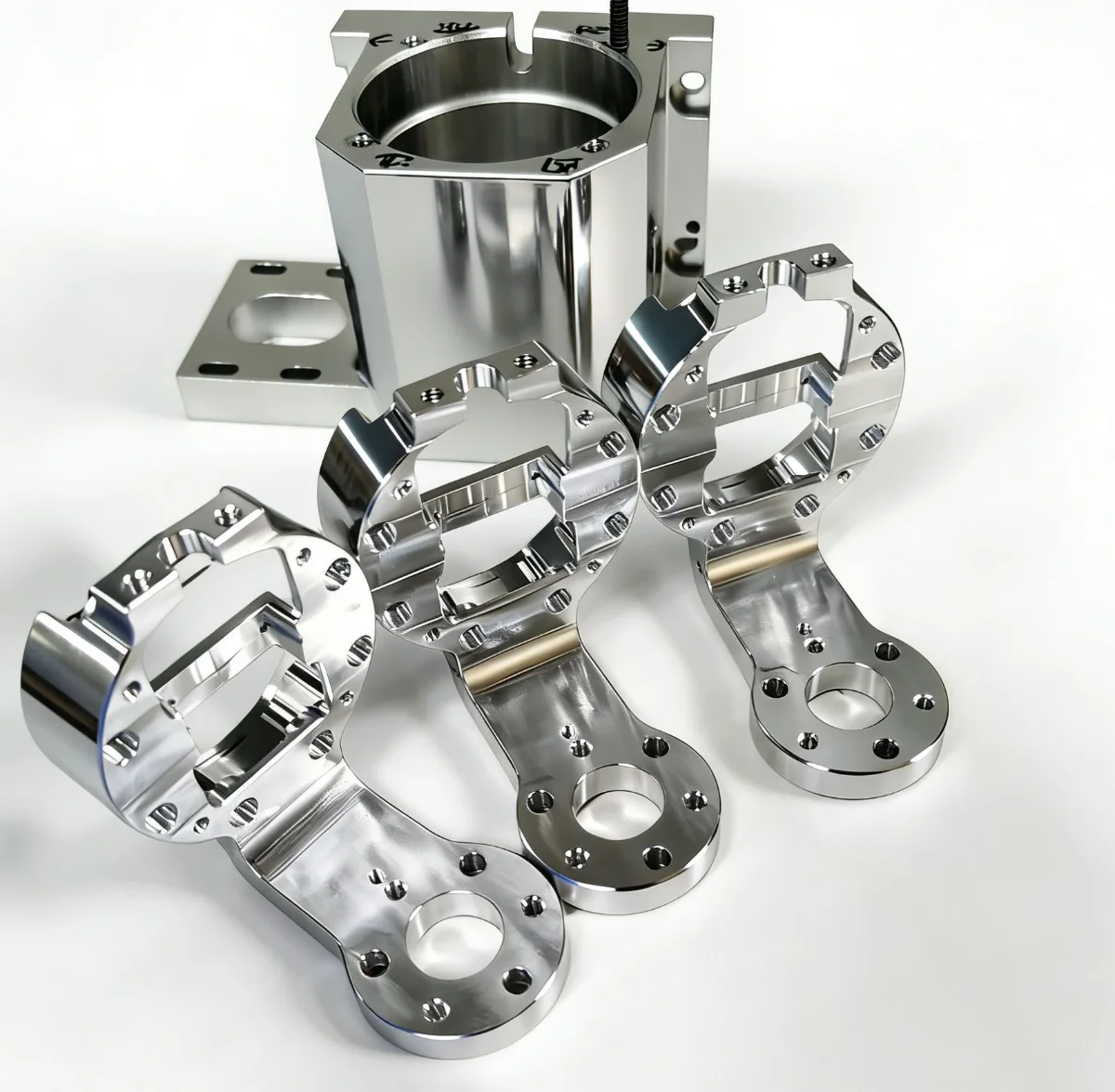
Elbow and shoulder joint brackets that a motor bolts straight into
These are the arms that carry a motor in a gimbal, a drone or a small robotic arm: a bearing seat at one end, a motor bolt pattern at the other, and a thin web between them that has to stay flat. We machine the family as a set — link, swing arm and the motor housing they mount to — so the bolt circles and bores are cut to the same datums and the joint goes together without shimming.
- Part familyJoint links, swing arms, motor housing
- Used inGimbals, drones, small robot arms
- Critical featuresBearing bore, bolt circle, web flatness
- FinishPolished bright
What buyers in this industry ask
How fast can you turn a revision around?
Can you hold concentricity between bores on different faces?
Do you do small assemblies?
How we make them
CNC Milling
Housings, plates and brackets on 3- and 4-axis centres. CNC milling →
CNC Turning
Shafts, bushings and fittings on twelve lathes. CNC turning →
Inspection
First article on the CMM before the run continues. Quality →
Ready for a quote?
Send the drawing — price and lead time within 16 hours. STEP, IGES, X_T, DWG, DXF or PDF.
No minimum order.