
Bead and Sand Blasting
Blasting is the cheapest way to make a machined part look finished: a uniform matte texture that hides light tool marks, evens out the surface and gives anodising something consistent to grow on. What it cannot do — and this catches people out — is remove a pattern. Texture is not geometry.
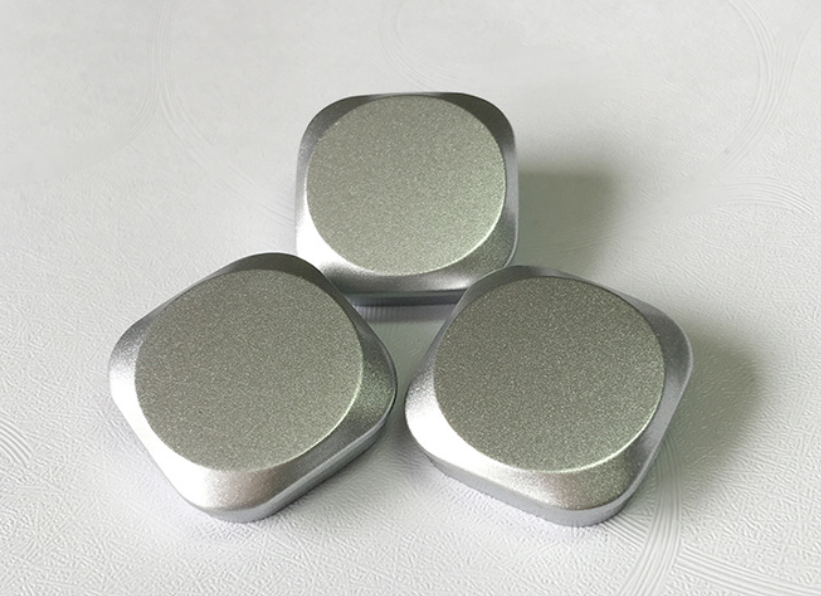
Media fired at the surface, and the media decides the look
Compressed air fires an abrasive at the part. Glass bead gives a soft satin grey; aluminium oxide cuts harder and leaves a coarser, more matte surface. Grit size and air pressure change the result as much as the media type does, which is why “bead blasted” on its own describes a family of finishes rather than one.
Blasting removes very little material, so it does not fix a dimension, but it does raise the roughness of the surface it hits. On a part that will be anodised afterwards this is usually the point: the blast makes every face look the same before the colour goes on, so the finished part has no shiny patches where a cutter happened to leave one.
The limit is worth stating plainly. Blasting disguises fine random scratches very well. It does not disguise a regular repeating pattern — a milling cusp, a stepover line, a chatter band — because the eye reads periodicity through the texture. If the marks are geometric they have to come off before blasting, at the machine or by hand.
| At a glance | |
|---|---|
| Process type | Mechanical abrasive texturing |
| Materials | Almost any metal, and some plastics with care |
| Typical media | Glass bead for satin, aluminium oxide for a harder matte |
| Effect on dimensions | Minimal — but it raises Ra and softens very fine detail |
| Common use | A base for anodising, or a finish in its own right |
| Limitation | Hides random scratches, not periodic machining marks |
| Typical parts | Enclosures, brackets, knife and EDC components, anything anodised afterwards |
When it is the right finish, and when it is not
Choose it when
- —You want a uniform matte with no shiny patches
- —The part will be anodised and must look consistent
- —Light handling marks or minor tool marks need disguising
- —Fingerprints on a bright surface are a problem
Choose something else when
- —A regular machining pattern is visible — fix that first
- —Fine engraving or sharp edge definition has to survive
- —The part has a mirror or bright requirement
- —Very thin or delicate features could be damaged by the media
What we need on the drawing
Three lines on the drawing remove almost all the uncertainty here.
Media and finish level
Glass bead or oxide, and fine, medium or coarse. If you have a sample of a finish you like, send it — that is worth more than any description.
Which surfaces get blasted
Usually all of them, but sealing faces, bearing bores and datum surfaces are often better left alone.
Whether anodising follows
If it does, we blast first and anodise after, and the blast level changes the final colour depth. Say so up front so the finisher plans the sequence.
Features that must stay as machined
Blasting removes very little material, but it takes the sharpness off edges and can roughen a sealing face or a fine thread. Mark threads, close-tolerance bores and sealing faces on the drawing; they are masked or plugged before blasting.
Send a sample of the finish you want
Send the drawing with the finish you have in mind, or with none at all and a sentence about where the part lives. You get a price, a lead time, and a note on anything in the finish that will fight your tolerances.