
CNC Machining PET
Machinable PET — PET-P, sold as Ertalyte among other names — is the quiet precision plastic. It holds tighter tolerances than acetal, absorbs almost no moisture, wears well, stays flat, and is cleared for food contact. It is the material for filling-machine parts, pump and valve components, gears, bushings and any plastic part that must be exactly the same size in six months as it was on delivery.
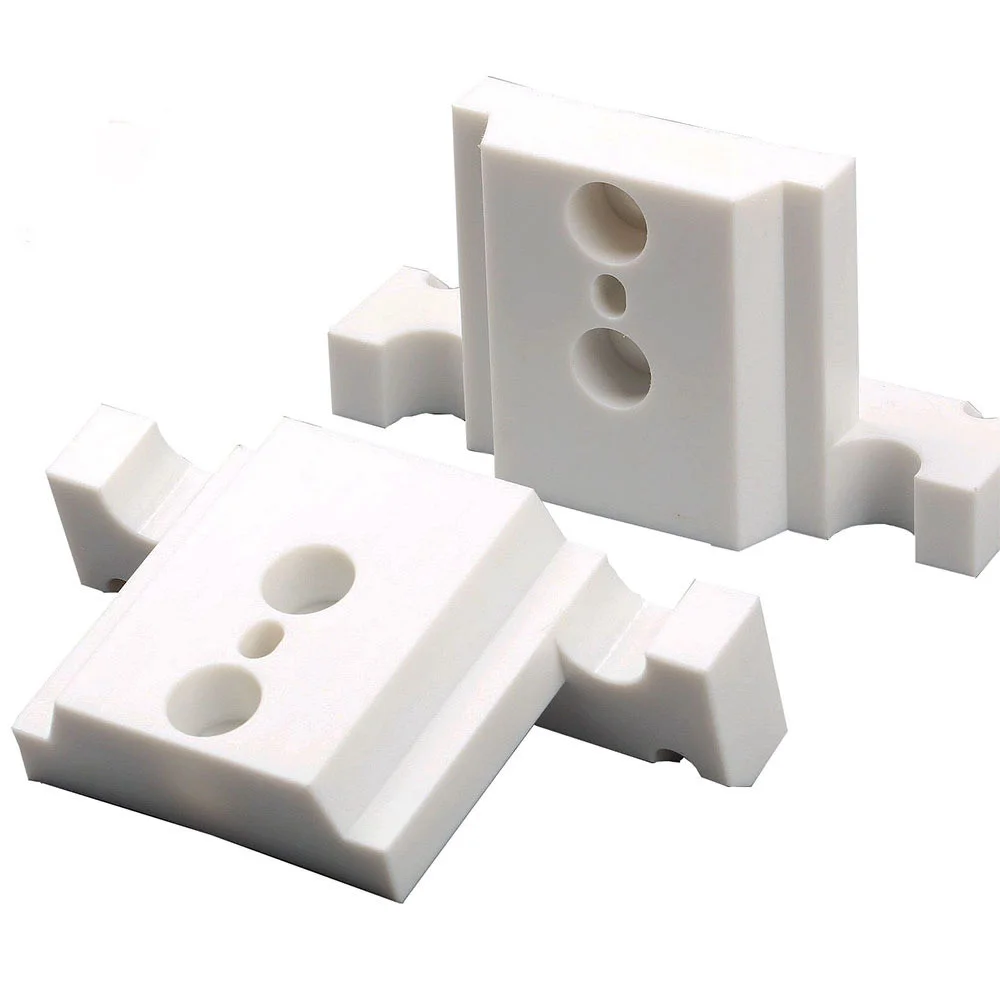
Grades and forms
Two grades cover almost every drawing: the natural stock for precision and food contact, the PTFE-filled grade for wear.
| Form / grade | Best for | Notes |
|---|---|---|
| PET-P natural (e.g. Ertalyte) | Precision food-machinery parts, pump and valve bodies, insulators | White or natural; best dimensional stability of the common engineering plastics; FDA-compliant |
| PET-P TX (PTFE-filled) | Bushings, wear rings, sliding parts, especially with soft metal counterfaces | Lower friction and better wear; light grey; still machines cleanly |
| Black PET | Parts where colour matters | Same properties, opaque black |
| Rod and plate | Turned parts from rod; plates and manifolds from sheet | Stock is stable; annealing is rarely needed except for heavy asymmetric machining |
Machines crisply and stays the size you cut
PET-P is one of the best plastics to machine: rigid, low friction on the tool, short chips, no smearing, and a bright, crisp finish from sharp carbide at moderate speeds. Fine threads, thin walls and small bores are routine, and edges come out sharp with almost no burr.
Its dimensional stability is the reason people specify it. Moisture absorption is very low, so a part does not grow in a humid plant; thermal expansion is lower than acetal; and internal stress is modest, so heavy machining does not move it much. Tolerances of ±0.05 mm are comfortable, tighter on request.
The material is notch-sensitive under impact and does not like hot water: above about 60 °C in water or steam it slowly hydrolyses and loses strength. Chemical resistance is otherwise good, and it is unaffected by most food-plant cleaners.
| At a glance | |
|---|---|
| Service temperature | Around 100 °C continuous in air; avoid hot water and steam |
| Dimensional stability | Excellent — very low moisture absorption and thermal expansion for a plastic |
| Wear | Good; the PTFE-filled grade runs as a dry bearing |
| Weakness | Notch-sensitive under impact; hydrolyses in hot water; not for sharp-cornered, shock-loaded parts |
| Typical parts | Filling and packaging machine parts, pump and valve components, gears, bushings and wear rings, insulators, precision spacers and fixtures |
Four rules for a PET part that holds its size
Use it where tolerance matters
If the part is being drawn in acetal to ±0.02 mm, PET-P will hold it more easily. If the tolerance is ±0.2 mm, acetal or HDPE is cheaper.
Radius corners on anything that is hit
PET is stiff and strong but notch-sensitive under impact. Internal corners R0.5 minimum on parts that see shock.
Keep it out of hot water
Wash-down at 60 °C is fine; continuous hot water or steam is not. For those conditions, look at polysulfone or PEEK.
Tell us if it runs against steel
PET-P is a quiet, low-friction bearing material and it holds size better than nylon or acetal. If the part slides, say so and say how fast, and we will comment on the clearance.
Ready for a quote?
Send the drawing — price and lead time within 16 hours. STEP, IGES, X_T, DWG, DXF or PDF.
No minimum order.