
Tumbling, Vibratory Finishing and Stone-Wash
Tumbling is how a batch of parts gets deburred and edge-broken without somebody sitting there with a file. Parts and abrasive media go into a barrel or a vibratory bowl together and rub against each other for hours. It is cheap per piece, it is genuinely good at what it does, and there are parts that must never go anywhere near it.
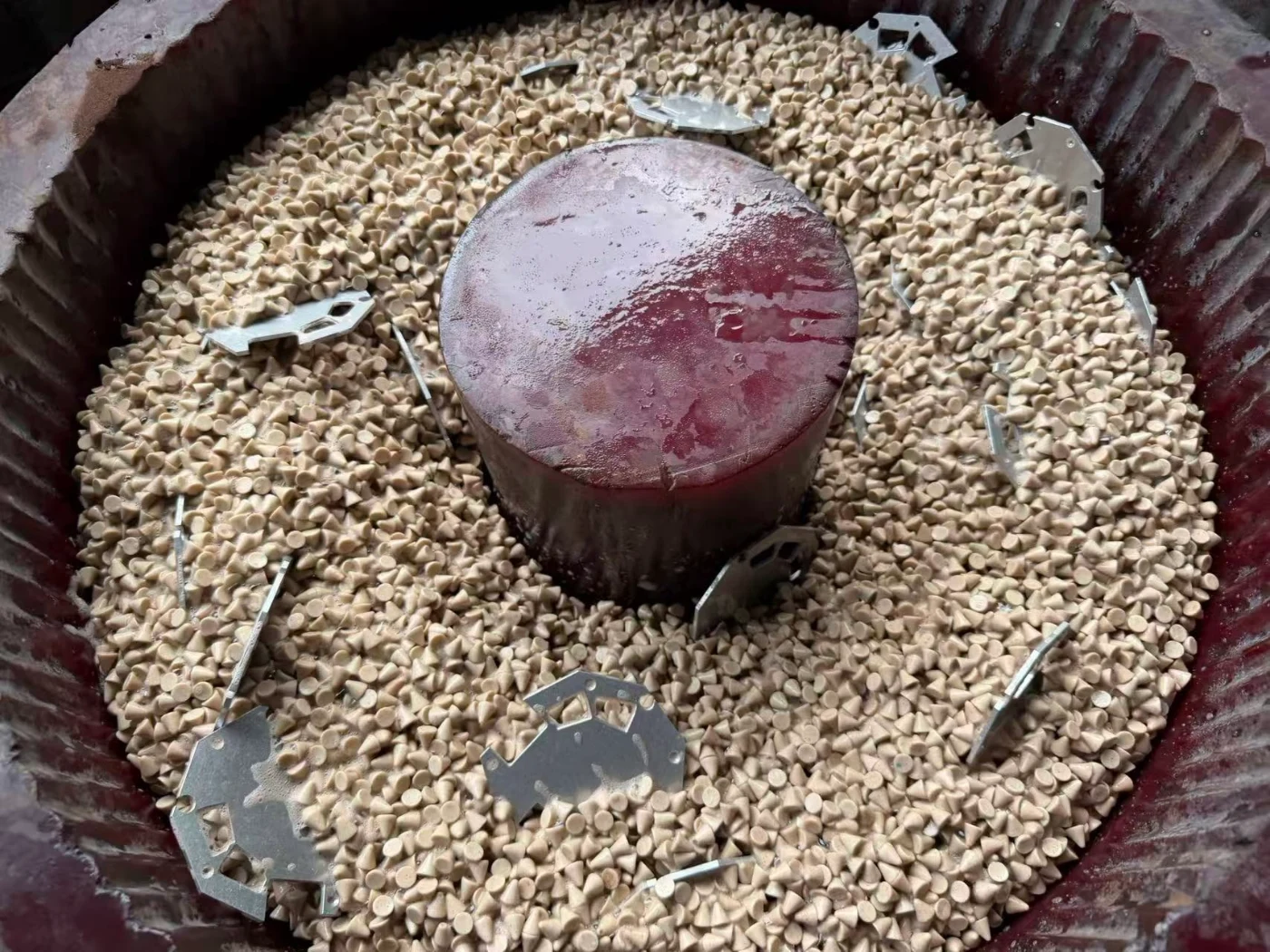
Parts, media and time
The media does the work: ceramic for cutting, plastic for gentler finishing, steel for burnishing, walnut shell or corn cob for drying and polishing. Change the media, the compound and the running time and the same machine will deburr aggressively, produce a soft even matte, or bring up a light shine.
The most valuable use is deburring. A machined part comes out of the barrel with every edge consistently broken, which is far more repeatable than hand deburring and much cheaper on quantity. Expect edges to round by a few hundredths of a millimetre — usually welcome, occasionally not.
Stone-wash is the same process run for appearance, most commonly on knives and EDC hardware. It gives the worn, used look that hides handling marks in service. It does not remove machining marks: like blasting, it changes the character of the surface, not its geometry.
| At a glance | |
|---|---|
| Process type | Mass finishing in a barrel or vibratory bowl |
| Materials | Most metals, and some plastics |
| Media | Ceramic, plastic, steel, walnut shell, corn cob |
| Effect on dimensions | Edges break and round by a few hundredths of a millimetre |
| Best at | Consistent deburring and edge-breaking across a whole batch |
| Cannot do | Remove a machining pattern — that is geometry, not texture |
| Typical parts | Hardware, brackets, small machined components, knife and EDC parts |
When it is the right finish, and when it is not
Choose it when
- —A batch needs consistent, repeatable deburring
- —A soft even surface is wanted before anodising
- —You want a worn, stone-washed look on EDC or knife parts
- —Hand deburring is too slow or too variable at your quantity
Choose something else when
- —Sharp edges are functional and must stay sharp
- —Parts are thin enough to bend or nest inside one another
- —Fine engraving or a knife edge must survive
- —Surfaces are already finished and cannot be touched
What we need on the drawing
Tumbling is specified by outcome rather than by process, so the useful information is about the part.
Which edges must stay sharp
The default is that all edges get broken. If a cutting edge, a sealing edge or a functional corner has to survive, mark it and it will be masked or the part will be hand-deburred instead.
Deburr or appearance
A deburring cycle and a stone-wash cycle use different media and different times. Tell us which one you are asking for.
Part geometry warnings
Thin, flexible or nesting parts can damage each other in a barrel. If your part is one of those, say so and we will suggest a fixtured or hand alternative.
Specified by us, applied by a partner, checked when it comes back
We machine in house and we do not run plating or coating tanks — tumbled finish is done by finishing shops in the Dongguan area that we have used for years. We write the specification, they receive parts and that specification and nothing else, and we inspect what comes back before it goes anywhere near your order.
Your drawing does not travel with the parts. What happens to your files → · Finishing is quoted as its own line, never hidden in the part price. How a machined price is built →
Send the part and tell us which edges matter
Send the drawing with the finish you have in mind, or with none at all and a sentence about where the part lives. You get a price, a lead time, and a note on anything in the finish that will fight your tolerances.