
Five hours of stone-washing did not hide the tool marks. So we stopped trying to hide them.
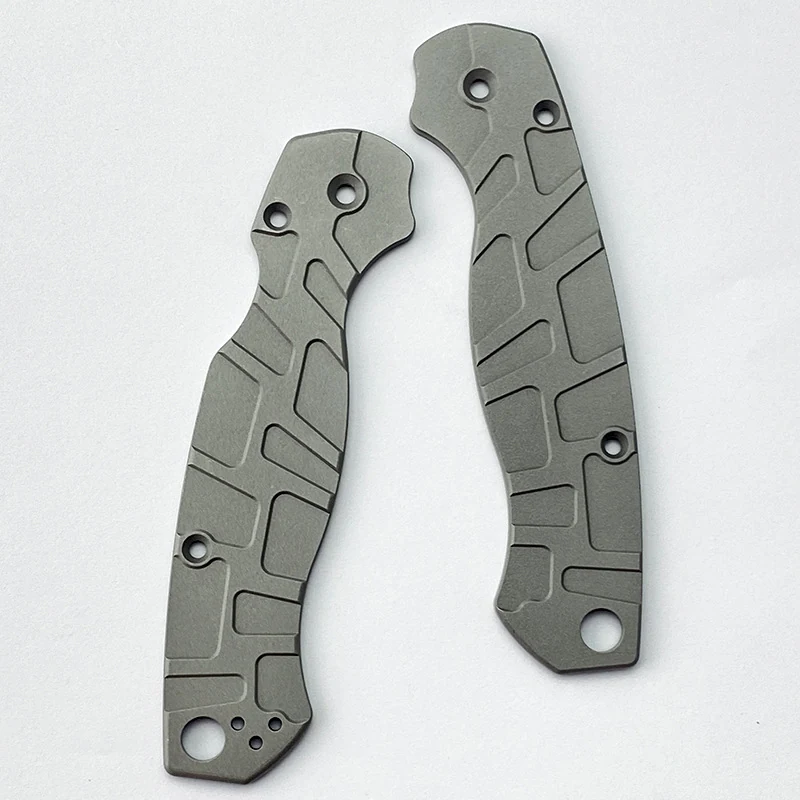
Ti-6Al-4V handle scales for a US knife brand we have supplied for five years — two models, 400 sets each. What went wrong, what we changed, and what it cost us.
What went wrong
The order was 800 sets of Ti-6Al-4V scales across two models, for a customer we have supplied for five years. The first scales came off the machine carrying visible tool marks. We ran them through the stone-wash for five hours, which is the finish the design called for and normally the thing that evens everything out. Under angled light you could still see the machining path with the naked eye.
That was the moment to be honest rather than optimistic. Stone-washing blends a surface; it does not remove a machining path that sits deeper than the media can reach. Another five hours would have rounded the edges and still left the marks. The problem was upstream, on the machine.
What we changed on the machine
Titanium scales are thin, broad and unforgiving, and almost every visible mark traces back to one of a handful of things. We rebuilt the process around them:
- Roughing and finishing fully separated. Roughing leaves 0.2–0.3 mm of stock. Finishing gets a fresh or barely-worn cutter of its own — never the roughing cutter used for one more pass because it is already in the spindle.
- Conservative finishing parameters. 40–60 m/min surface speed, 0.03–0.05 mm per tooth, 0.1–0.2 mm depth of cut. Titanium punishes high surface speed harder than it punishes low feed.
- Stepover tight enough that blasting can absorb what is left. Flat faces with a flat or bull-nose end mill at under 30% of cutter diameter; curved faces with a ball nose, the stepover back-calculated from scallop height — in practice 0.1–0.15 mm is where the path stops showing after blasting.
- Sharp, titanium-specific tooling. High-helix, variable-pitch cutters with an AlTiN coating, and edge sharpness treated as the first priority rather than tool life. Short overhang, shrink-fit or hydraulic holders, to keep runout out of the finish.
- Climb milling and real coolant pressure — through-spindle or high-pressure flood aimed at the cutting edge. Titanium run dry or under-cooled wears a tool in minutes, and the marks deepen the moment it does.
- A spring pass to finish. The same path run again at the same depth, taking off what elastic recovery left behind.
- Workholding that supports the whole part. A scale is exactly the geometry that resonates. A form fixture or vacuum plate under the entire back face, instead of a vice gripping two ends.
What we did with the parts already cut
Those could not be saved by finishing alone, and we said so instead of shipping them and hoping. The marks had to come off mechanically: hand sanding from 240 grit through 400 to 600 until the path is flat, or a pass through vibratory or magnetic finishing. Then blasting — 80–120 grit first to even the whole surface, then fine media. With the marks actually gone, the stone-wash only needs one to two hours to do its job.
Surface before blasting comes in around Ra 0.8 µm. After blasting and a short stone-wash it is a uniform matte, with no machining path visible at any angle.
What it cost us
The rework put the order five days late. We told the customer why rather than inventing a shipping excuse, gave them a discount for the delay, and shipped parts that matched what they had approved. They have kept ordering since — five years and counting.
- PartKnife handle scales
- MaterialTi-6Al-4V
- Quantity2 models × 400 sets
- ProblemTool marks visible after 5 h stone-wash
- FixSeparate rough/finish, Ti parameters, spring pass, form fixture
- Delay5 days, discount given
- ResultStill ordering — 5-year customer
Send us the part that is giving you trouble
The jobs worth writing up are the awkward ones. Send the drawing and tell us what has gone wrong before, and we will tell you what we would do differently.