
Titanium chains
A pure titanium chain is not a fashion shortcut. It is a different material decision: roughly 40% lighter than stainless steel, nickel-free, resistant to sweat and chlorine, and able to take colour without paint or dye. This guide covers the ten chain styles we supply, the grades behind them, the sizes and clasps that matter, and how to specify a chain that survives daily wear.
Who this is for: jewelry brands, EDC and accessory makers, and buyers sourcing titanium chains for necklaces, bracelets, bag straps, shoe chains, phone lanyards, dog tags and keychains. If you need a lightweight, skin-friendly chain that can be anodised, start here.
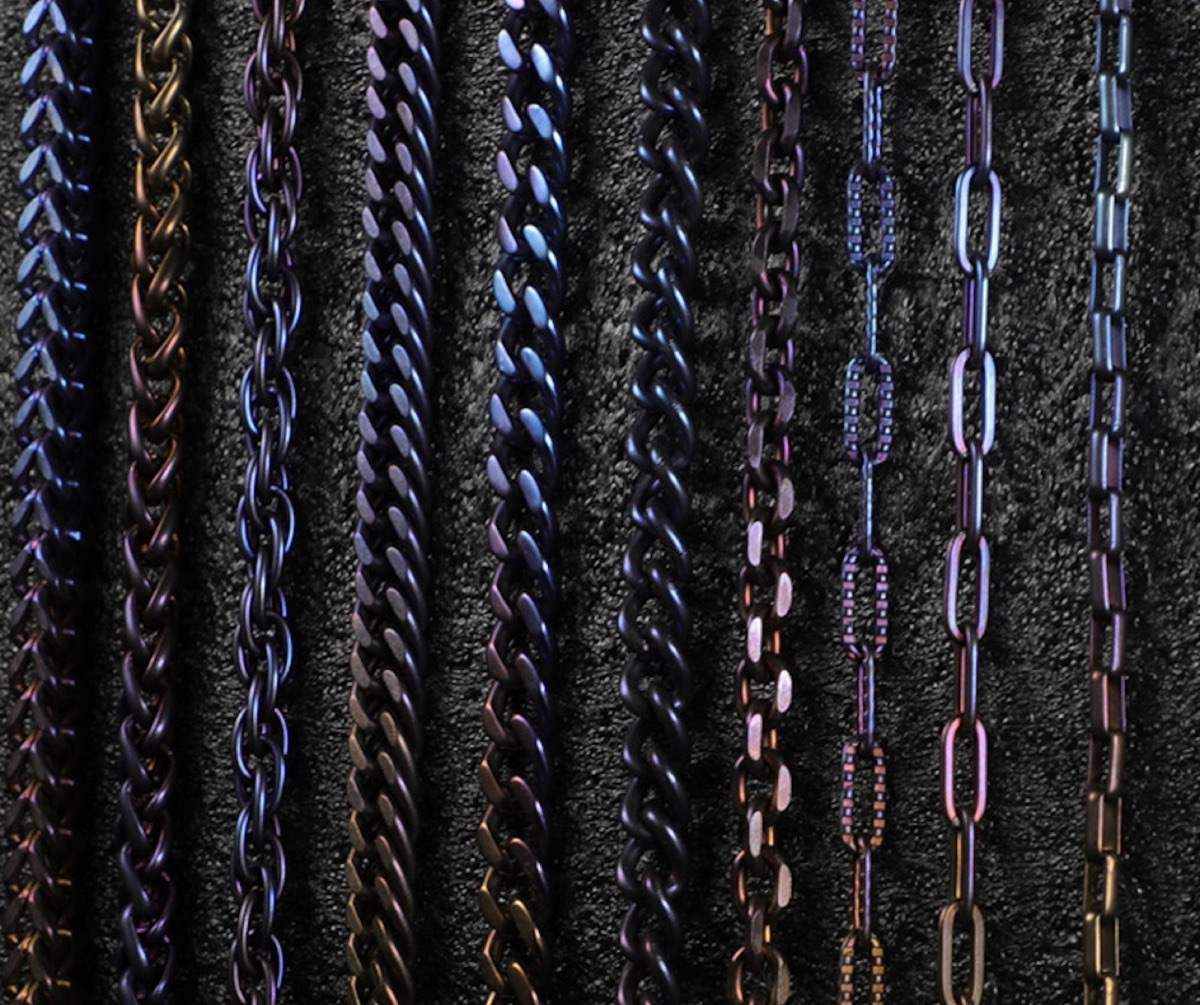
Quick answer: why choose a pure titanium chain?
- Light: titanium density is about 4.51 g/cm³, versus roughly 7.9 g/cm³ for stainless steel. A 3 mm chain feels noticeably lighter on the neck.
- Skin-friendly: commercially pure titanium Grade 1/2 contains no added nickel. It is a common choice for sensitive skin and daily wear.
- Corrosion-resistant: the passive oxide layer resists sweat, seawater and chlorine. It does not need plating to stay silver.
- Colour without dye: anodising grows an oxide layer whose thickness produces blue, purple, gold, bronze, green and pink by light interference.
- Strong for its weight: Grade 2 is not the strongest metal in absolute terms, but its strength-to-weight ratio and fatigue resistance are excellent for chain links.
- Comfortable: low thermal conductivity means it does not feel as cold as steel when it first touches the skin.
Why pure titanium works for chains
Chain is a difficult shape for any metal: many small links, repeated movement, skin contact, sweat, perfume, chlorine and sunlight. Titanium handles that combination better than most jewelry metals because its corrosion protection is not a coating. The surface is a thin, stable titanium dioxide layer that re-forms if scratched in air or water.
That matters for a necklace worn every day. Plated brass and some stainless chains rely on a surface layer; once it wears through, the base metal shows. A pure titanium chain is the same colour through the link. If the surface is scratched, it can be re-polished or re-blasted without exposing a different metal.
Titanium also has a different feel. It is warmer to the touch than steel, lighter on the neck, and does not give the “heavy chain” sensation unless you choose a wide, solid style. For earrings, bracelets and long necklaces, that weight difference is the reason many buyers switch.
Grade 1, Grade 2 and Grade 5: what “pure titanium” means
“Pure titanium” normally means commercially pure titanium, not the Ti-6Al-4V alloy. The common grades are:
| Grade | Composition | Typical use | What to know |
|---|---|---|---|
| Grade 1 | Commercially pure, lowest oxygen | Softest, most formable; fine jewelry and delicate links | Easiest to bend and polish; lower strength |
| Grade 2 | Commercially pure, standard oxygen | Most jewelry chains, clasps, tags and EDC | The default for a balance of strength, finish and price |
| Grade 5 | Ti-6Al-4V alloy | High-strength industrial and aerospace parts | Stronger, but not “pure titanium”; different colour response |
For chains, Grade 2 is usually the right starting point. It is strong enough for 1.2–4.5 mm links, takes a clean polish or brushed finish, and anodises predictably. Grade 1 is softer and can suit very fine, delicate chains where formability matters more than strength. Grade 5 is an alloy; if a customer asks for “pure titanium”, do not substitute Grade 5 without saying so.
Ask for the mill certificate if the grade matters. The certificate should show the grade, heat number and chemical composition. A “titanium” label without a grade is not enough for a jewelry brand that makes a hypoallergenic claim.
The 10 chain types, and what each one is good at
The chain style decides how the necklace hangs, how strong it is, how it feels and what it costs. The names below are the ones buyers use; some styles have regional names, so use a photo and a sample as well as a name.
1. Cable chain (O-ring chain)
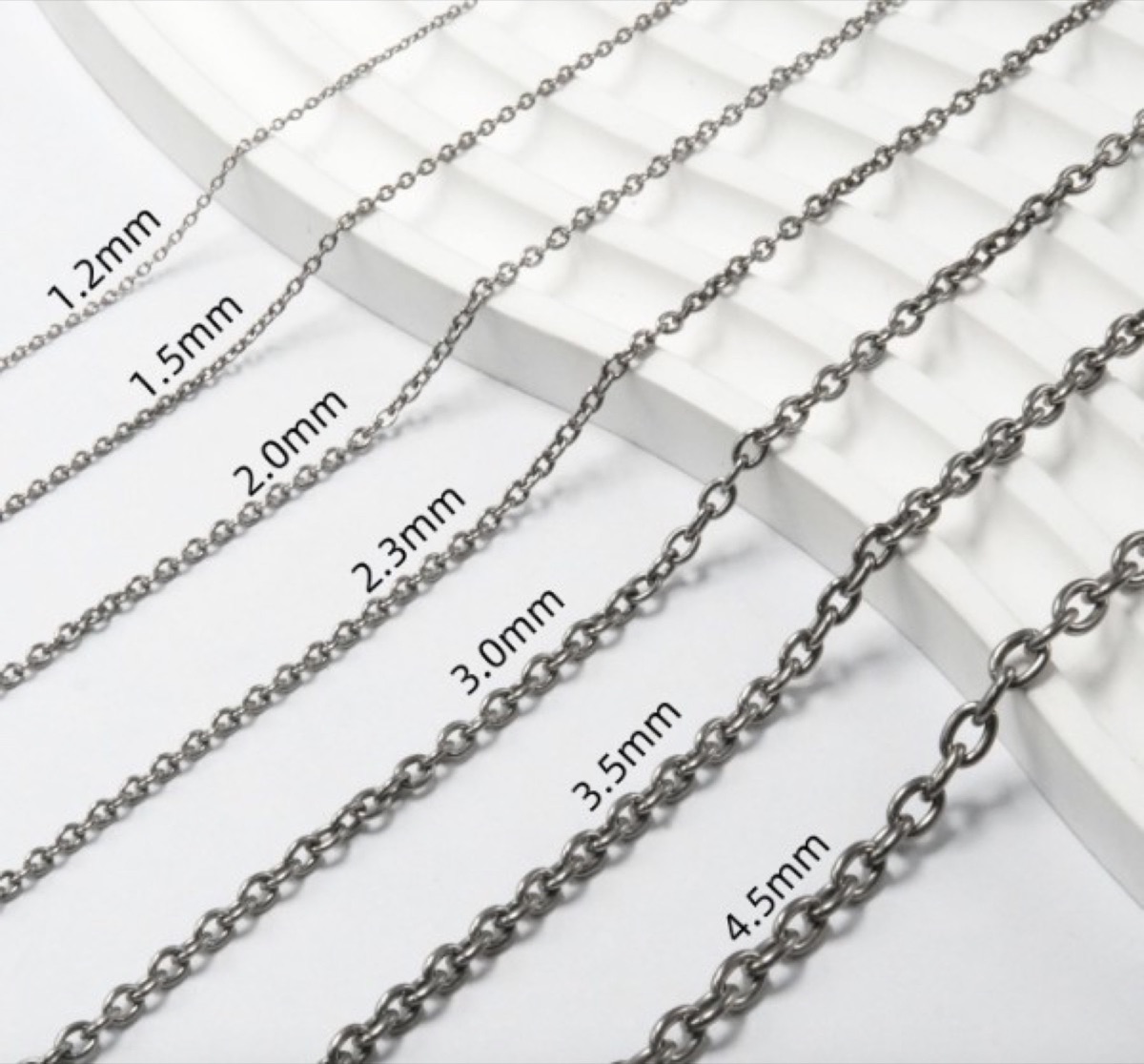
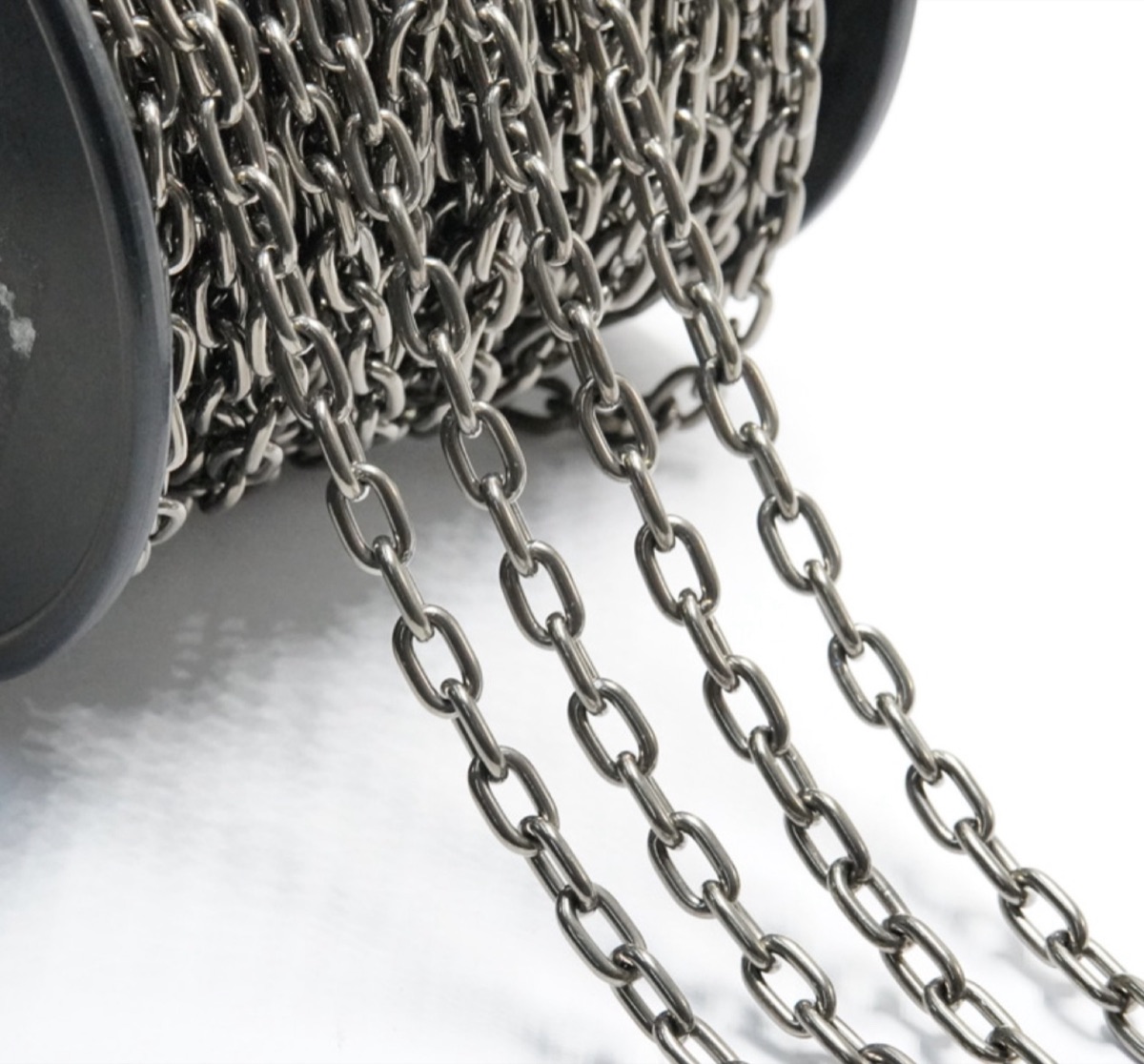
Oval or round links interlocked at 90 degrees. It is the most basic chain, flexible in all directions, economical and easy to repair. Cable is the right choice for pendants, delicate necklaces, bracelets and dog tags. Common widths are 1.2, 1.5, 2.0, 2.3, 3.0, 3.5 and 4.5 mm.
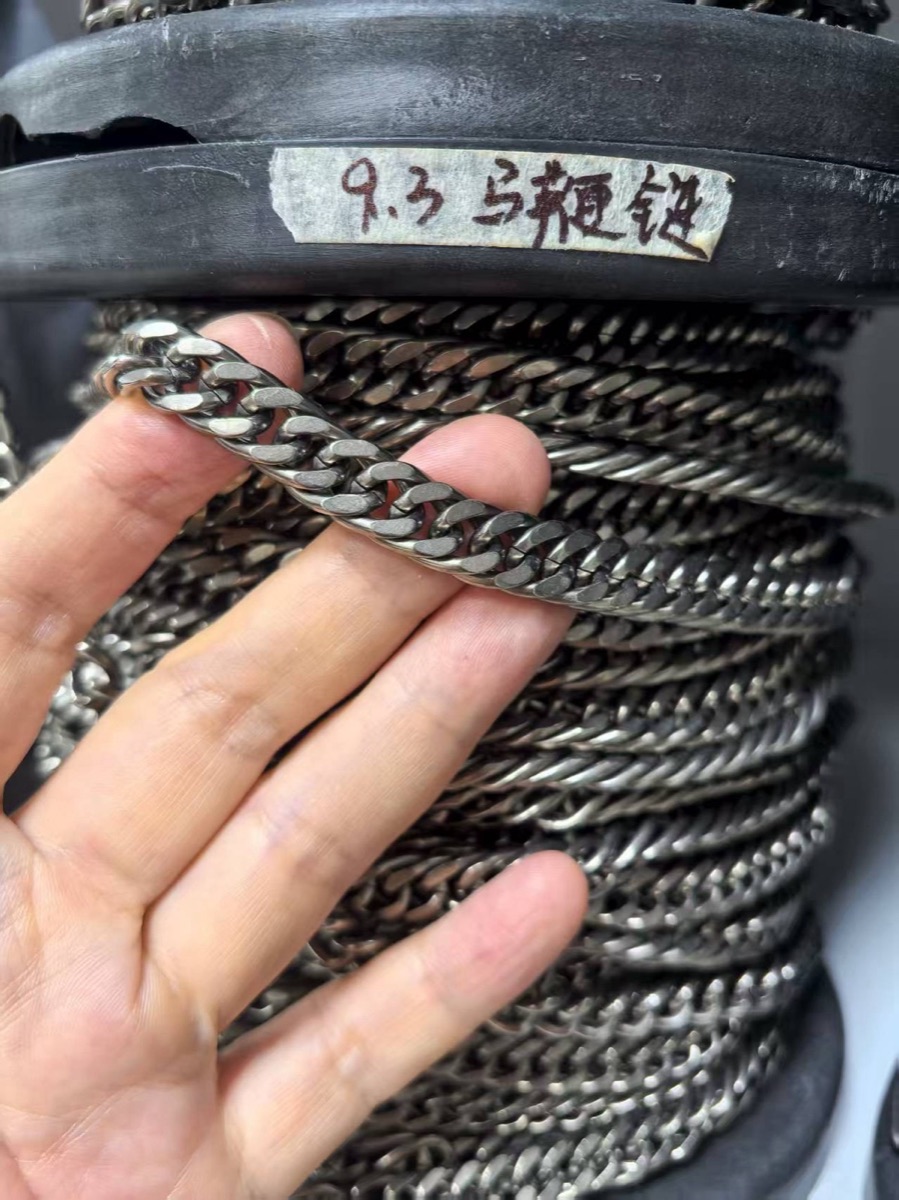
2. Curb chain / Cuban link
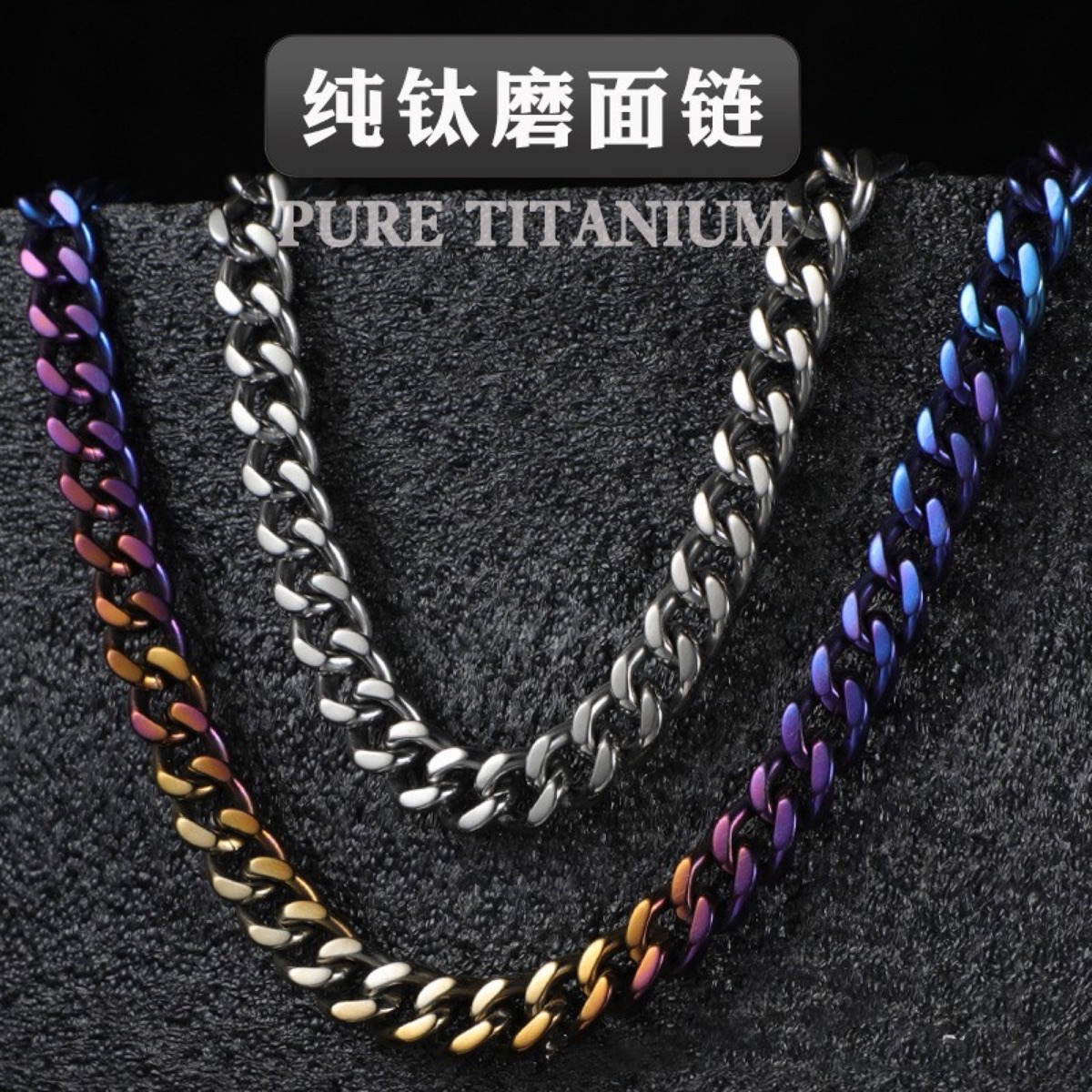
Links are flattened and twisted so the chain lies flat against the skin. A Cuban link is a tight, specific curb pattern with closely fitted links. Curb is stronger and more substantial than cable at the same width, and it is the classic men’s necklace style. It also anodises well because the flat faces catch colour evenly.
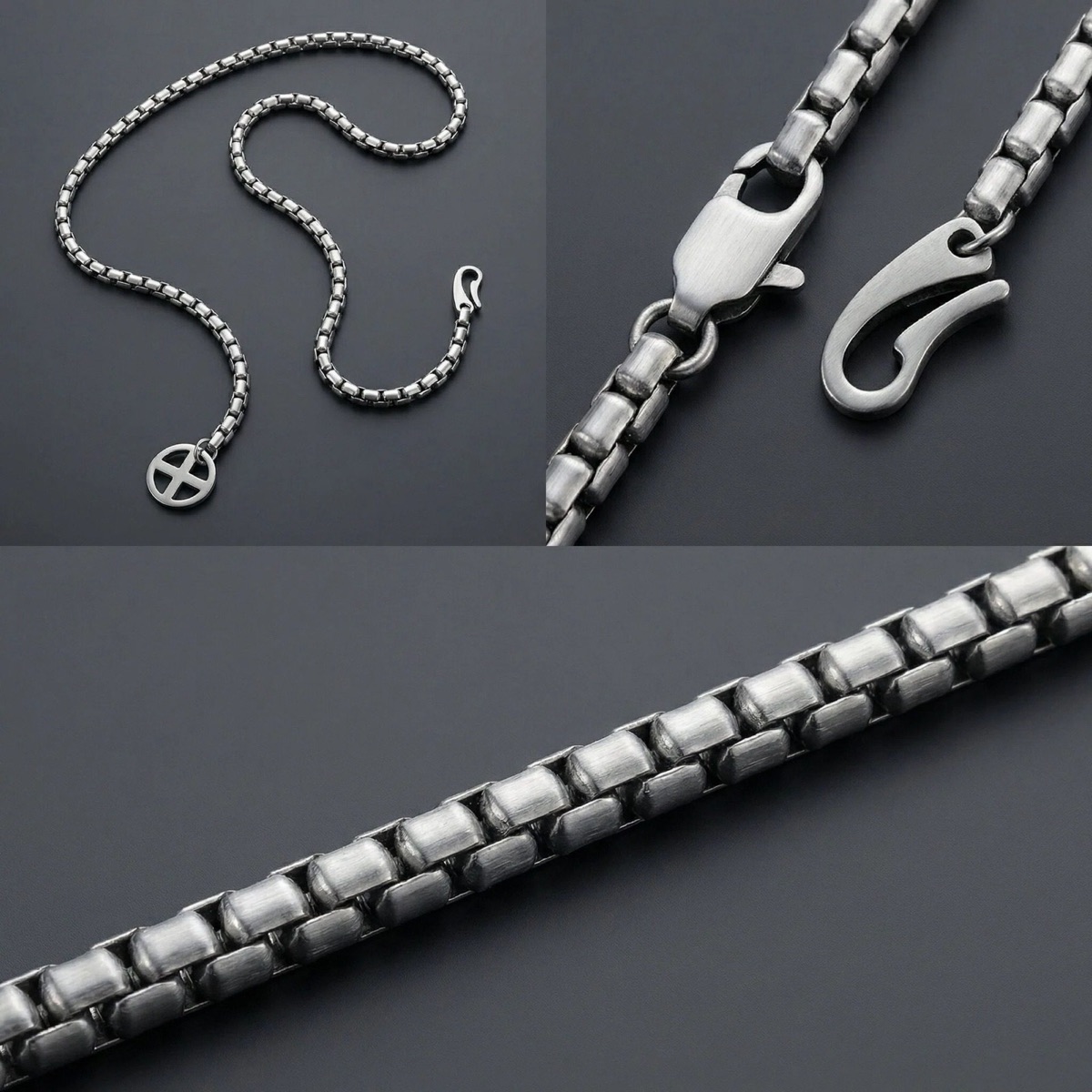
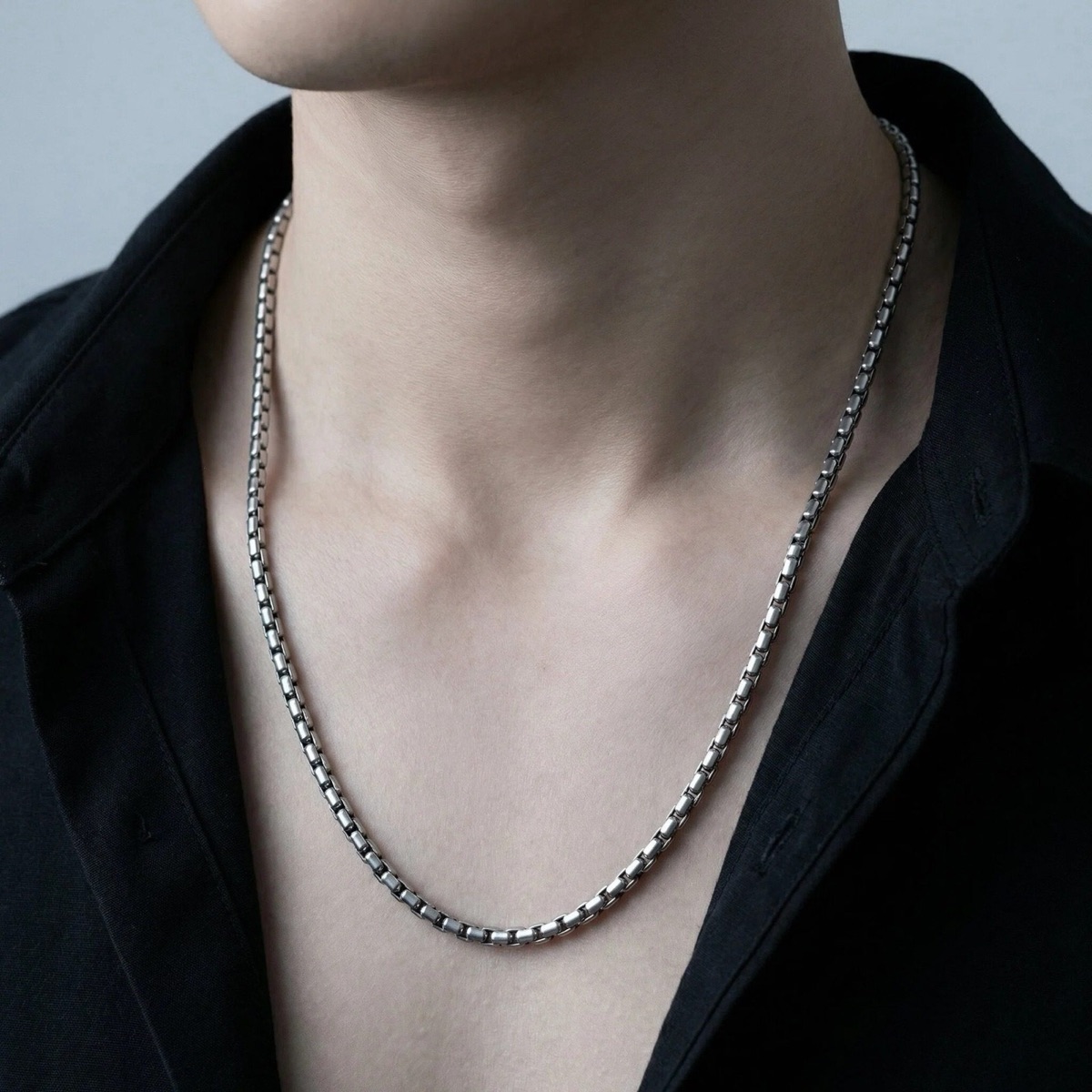
3. Box chain / Venetian chain
Square links create a straight, architectural chain with a smooth profile. Box is strong and does not twist easily, but it is less flexible than cable. It suits minimalist necklaces, pendants and bracelets. A box chain can kink if bent sharply, so the link geometry and the clasp matter.
4. Rope chain
Multiple strands are twisted into a rope-like pattern. The look is classic and substantial, with more sparkle than a cable chain. Rope is flexible and strong, but the twist can catch on delicate clothing. It is a good choice for pendants and statement necklaces.
5. Figaro chain
An Italian pattern: three short links followed by one long link, repeating. Figaro is flatter and more decorative than cable, and it is often used for men’s bracelets and necklaces. The pattern must be consistent across the length; a stretched or uneven repeat is a quality defect.
6. Ball chain / bead chain
Small titanium spheres are connected by short bars. It is lightweight, flexible and inexpensive, and it is the standard for dog tags, keychains and ID holders. The connector and the ball joint are the weak points, so ask for a pull test.
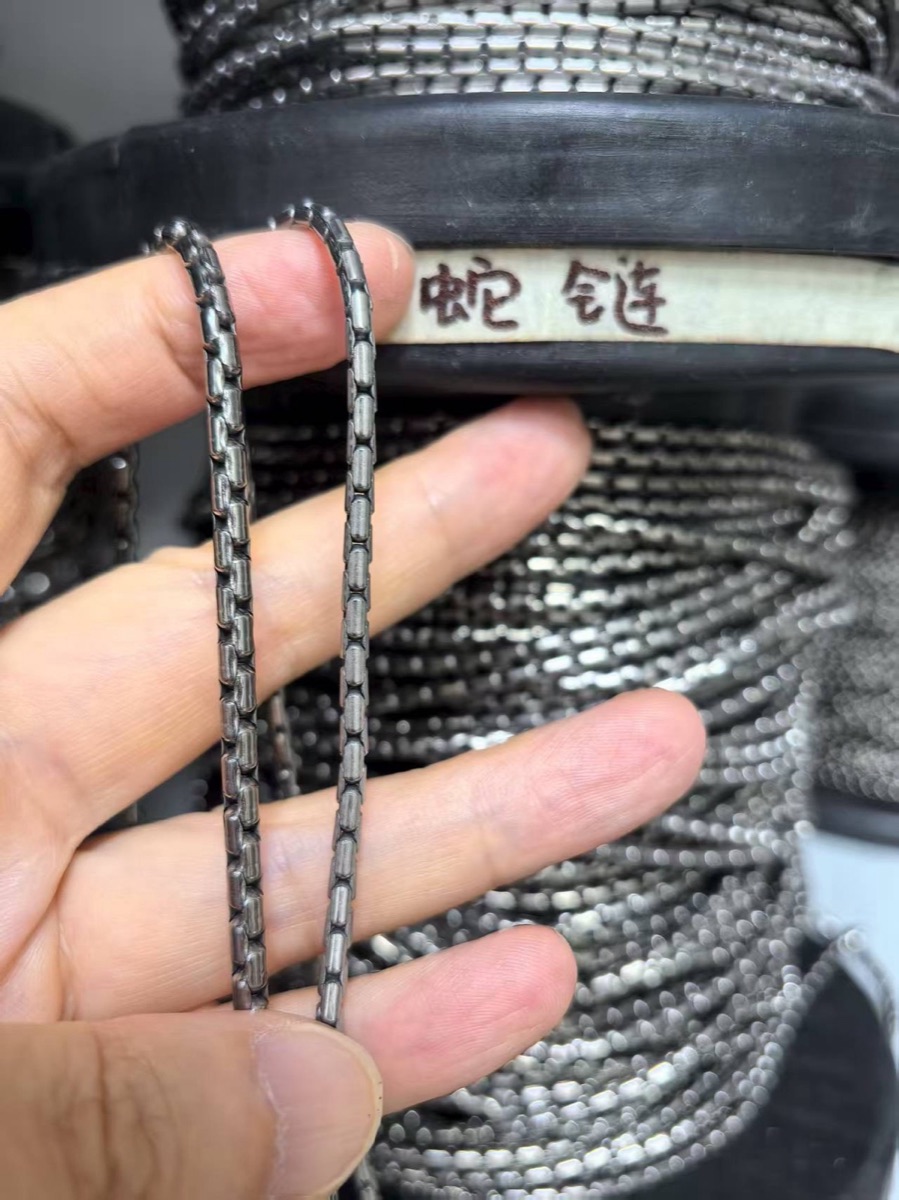
7. Snake chain
Close-fitting curved plates create a smooth, liquid surface. Snake chain looks like a solid tube but flexes in one direction. It is elegant for pendants and minimalist necklaces, but it can kink if bent sharply or stored in a tight loop. A heavier wall and a good clasp reduce the risk.
8. Wheat chain / Spiga chain
Four oval links are braided into a wheat-like pattern. The result is strong, flexible and flatter than a rope chain. Wheat is a good unisex style and works well in 2.5–5 mm widths. The braid must be tight; loose braiding feels soft and wears faster.
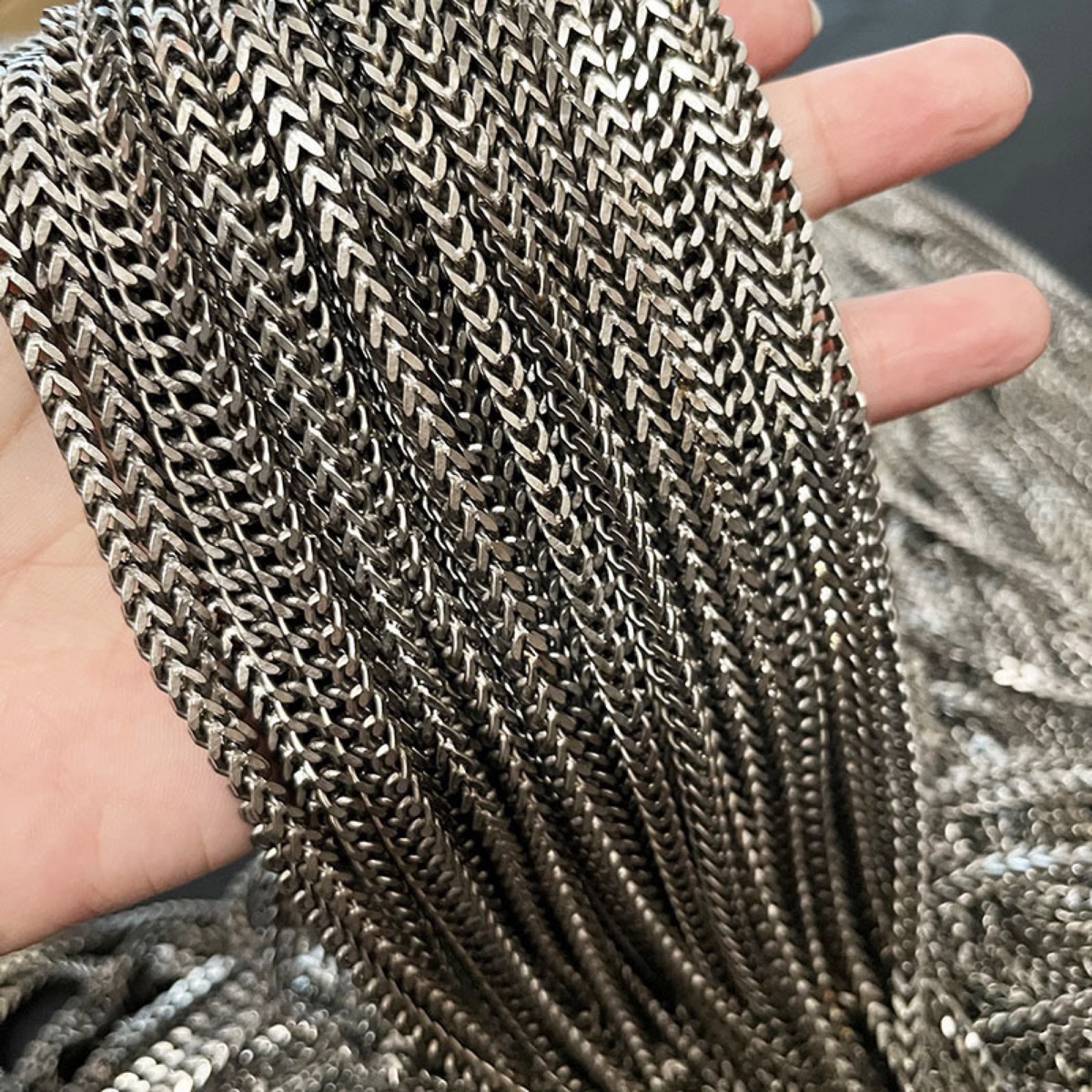
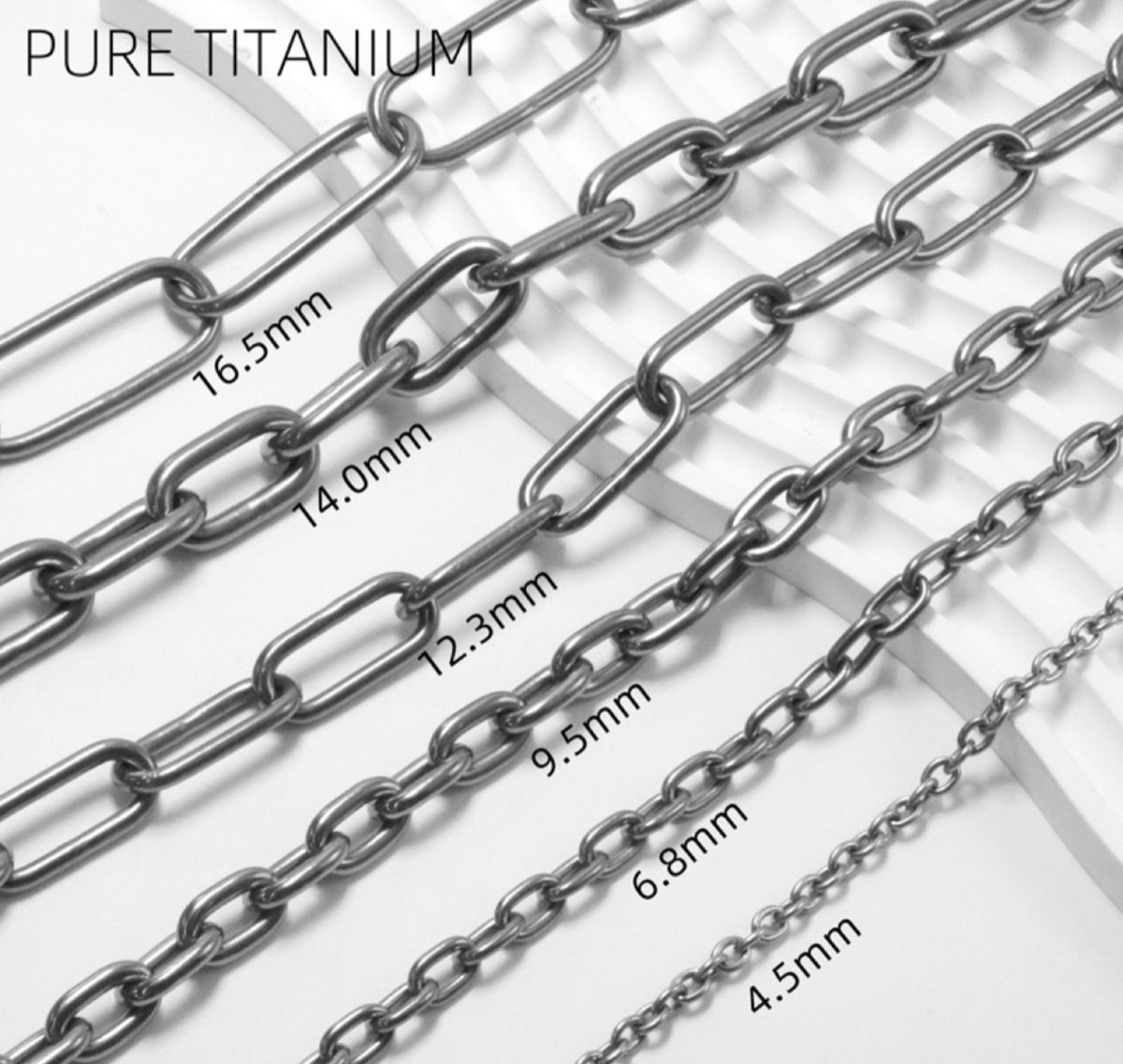
9. Paperclip chain
Elongated rectangular or oval links create a modern, open look. Paperclip is lightweight for its visual size, which suits titanium. It is popular for layering, oversized necklaces and bag chains. The open link shape is less strong than a tight curb, so choose the wire diameter for the load.
10. Mariner chain / anchor chain
Oval links with a crossbar in the centre, inspired by anchor chain. The crossbar adds structure and a nautical look. Mariner is a good choice for bracelets and men’s necklaces where you want a recognizable pattern without the weight of a Cuban link.
Titanium vs stainless steel vs sterling silver
| Property | Pure titanium (Grade 2) | Stainless steel 316L | Sterling silver 925 |
|---|---|---|---|
| Weight | About 4.51 g/cm³; lightest | About 7.9 g/cm³ | About 10.4 g/cm³ |
| Skin contact | No added nickel; good for sensitive skin | Contains nickel; low release for many people, but not nickel-free | Contains copper; some people react |
| Corrosion | Excellent in sweat, seawater and chlorine | Good, but can pit in chlorides | Tarnishes; needs polishing |
| Strength | Good strength-to-weight; Grade 2 is not the hardest metal | Higher absolute tensile strength | Soft; easily scratched and bent |
| Colour | Silver-grey; anodises to blue, purple, gold, bronze, green | Silver; plating can wear | White; tarnishes to black |
| Best for | Light daily wear, sensitive skin, colour, EDC | Heavy-duty budget chains | Fine jewelry and traditionallooks |
The honest summary: stainless steel can be stronger in absolute terms and cheaper; sterling silver has the traditional jewelry look; titanium wins on weight, skin compatibility, corrosion and colour. If a customer wants the lightest possible 4 mm chain that will not tarnish, titanium is the clear choice.
Sizes, lengths and clasps
Chain size is usually the link width in millimetres, not the length. The same 3 mm cable and 3 mm curb feel completely different because the link geometry and weight per metre differ. Ask for both the width and the weight per metre.
| Use | Typical width | Typical length | Notes |
|---|---|---|---|
| Delicate necklace | 1.2–2.0 mm | 16–18 in / 40–45 cm | Cable, box, snake |
| Daily necklace | 2.3–3.5 mm | 18–22 in / 45–55 cm | Cable, curb, wheat |
| Statement necklace | 4.5–7.0 mm | 20–24 in / 50–60 cm | Curb, paperclip, mariner |
| Heavyweight chain | 7.0–9.3 mm | 20–24 in / 50–60 cm | Cuban, curb; check weight |
| Bracelet | 1.5–5.0 mm | 7–9 in / 18–23 cm | Add 1–2 cm for comfort |
| Dog tag / keychain | 2.0–3.0 mm ball | 24–30 in / 60–75 cm | Ball chain; check connector |
Clasps matter as much as the chain. A lobster clasp is secure and easy to use; a trigger clasp is smaller and neater; a toggle clasp is decorative but can open under load; a magnetic clasp is convenient but not for heavy pendants. If the chain is titanium, ask whether the clasp is titanium or a stainless component. A stainless clasp is common and acceptable, but it should be disclosed.
Finishes and anodised colours
Titanium can be left as-machined, polished, brushed, bead-blasted or anodised. The finish changes how the colour reads: a polished surface is bright and reflective; a blasted surface is diffuse and softer. The same voltage can produce a different colour on a different finish, so approve a sample in the shipping finish.
Anodising is not paint or dye. The chain is immersed in an electrolyte and a voltage is applied; the oxide thickness grows and interferes with light. Lower voltages give bronze and purple; higher voltages give blue, gold, pink and green. The colour is part of the metal surface, so it does not flake like plating, but it can still be scratched by abrasive wear.
If you need a specific Pantone or a repeatable colour across production, send a physical sample and state the finish. A photo is not a colour reference. For more on the process, see our guide to anodised titanium colours.
Applications and daily wear
Pure titanium chains are used wherever weight, skin contact and corrosion matter:
- Jewelry: necklaces, bracelets, anklets and pendants for daily wear.
- EDC and accessories: keychains, lanyards, pocket-clip chains, beard-comb chains and bag hardware.
- Dog tags and ID: ball chains for military-style tags, medical alert tags and staff IDs.
- Eyewear: glasses chains and reading-glass cords that sit on the skin.
- Fashion and streetwear: oversized paperclip and Cuban links, anodised colours, layered necklaces.
- Outdoor and marine: chains that see sweat, salt water and chlorine without rusting.
Bag and handbag chains
Replacement shoulder straps, crossbody chains, wristlet chains and decorative purse chains are one of the fastest-growing uses for titanium. The appeal is weight: a 1 m bag chain in titanium is noticeably lighter than the same chain in steel, and it will not tarnish the leather or leave a metallic smell.
For a bag, the chain is a load-bearing part, not just trim. A handbag can weigh 2–10 kg, and the chain is repeatedly lifted by one point. Choose a closed-link style such as curb, Cuban, box or wheat in 4.5–9.3 mm, with a swivel snap hook or a strong lobster clasp. Avoid open paperclip or ball chain for a heavy bag unless the wire diameter and connector are rated for the load. Ask for a pull test on the assembled strap, not just the chain.
Length is usually 60–120 cm for a shoulder or crossbody strap. Match the titanium colour to the bag hardware: natural silver, black, gold, bronze or blue. If the chain runs through leather loops, specify smooth link edges and a polished finish so it does not cut the leather.
Shoe chains and sneaker accessories
Shoe chains, boot chains and detachable ankle chains use the same titanium advantage: light, colour-stable and comfortable against the ankle. A sneaker chain is usually 2.0–3.5 mm cable, ball or box, 20–35 cm long, with a small clasp that will not scratch the shoe or the skin.
For a boot chain, choose a curb or box chain in 3.0–5.0 mm and add a connector that can be clipped to the boot eyelets or around the ankle. Keep the weight low; a heavy chain on a moving foot becomes uncomfortable quickly. Anodised blue, purple and gold are popular for limited editions and seasonal drops.
Phone chains and crossbody straps
A phone chain has to carry 150–400 g without digging into the neck or shoulder. The best styles are 1.5–3.5 mm cable, box or ball chain, with a phone patch or a reinforced connector rather than a thin split ring. Crossbody phone chains are usually 100–140 cm; wrist chains are 20–30 cm.
Check the connector first. The chain may be strong, but a cheap patch or clip is the weak point. Ask for a load test on the assembled product, and specify an adjustable buckle if the same chain will be worn by different people. Titanium is a good match for phone chains because it is light, does not tarnish and does not irritate the neck.
Glasses, ID and keychain chains
Glasses chains, badge holders, keychains and luggage tags use 1.2–3.0 mm cable or ball chain. The priority is light weight and a secure connector. For glasses, use silicone or rubber ends so the chain does not scratch the frame; for ID badges, a 2.0–3.0 mm ball chain with a split ring is enough.
Keychains and pocket-clip chains can use 2.5–4.0 mm curb or box for a more substantial look. If the chain will be pulled or clipped to a belt, specify a closed link and a clasp rated for the load.
Garment, hat and fashion details
Titanium chain is used as a detachable garment detail: hat chains, belt chains, jacket loops, bag charms and limited-edition streetwear. The chain must be smooth, lightweight and colour-fast. A 2.0–4.0 mm cable or curb chain in anodised blue, purple or gold is a common choice.
For garment use, ask for a finish that will not snag knitwear, and specify whether the chain will be washed or dry-cleaned. Anodised colour is durable but can be abraded by hard surfaces, so a polished finish is easier to clean than a deep blast.
Pet tags, luggage and outdoor gear
Pet tag chains and luggage tag chains need a stronger clasp and a closed link. Use 2.5–5.0 mm curb, box or ball chain, 20–40 cm long, with a welded or securely closed link. Titanium is a good choice for outdoor gear because it does not rust in rain or seawater and does not add much weight.
Do not use a decorative chain as a tie-out or a leash. A tag chain only needs to hold the tag; a load-bearing chain needs a rated connector and a pull test.
Application selection table
| Application | Best chain styles | Typical width | Typical length | What matters |
|---|---|---|---|---|
| Handbag strap | Curb, Cuban, box, wheat | 4.5–9.3 mm | 60–120 cm | Closed links, swivel snap, pull test |
| Shoe / sneaker chain | Cable, ball, box | 2.0–3.5 mm | 20–35 cm | Light weight, smooth edges, small clasp |
| Phone chain | Cable, box, ball | 1.5–3.5 mm | 100–140 cm | Connector patch, adjustable length |
| Glasses chain | Ball, cable | 1.2–2.5 mm | 60–75 cm | Silicone ends, light weight |
| ID / keychain | Ball, cable, curb | 2.0–4.0 mm | 60–75 cm | Split ring, secure clasp |
| Pet tag | Ball, curb, box | 2.5–5.0 mm | 20–40 cm | Closed link, stronger clasp |
| Garment detail | Cable, curb | 2.0–4.0 mm | Custom | Detachable, smooth, colour-fast |
The daily-wear test is simple: wear it for a week, shower in it, exercise in it, and see how it feels. A titanium chain should not leave a green mark, should not feel heavy at the end of the day, and should not need polishing to stay silver. The anodised colour may dull slightly at high-friction points, but the metal underneath is the same.
Quality checks and custom supply
Chain quality is not only the metal grade. It is the link geometry, the closure, the surface and the consistency across the batch. When you evaluate a supplier, ask for:
- Grade certificate: Grade 1 or 2, with heat number.
- Link dimensions: wire diameter, inner link size, pitch and weight per metre.
- Pull test: a sample from the batch tested to the agreed load.
- Clasp test: open/close cycles and a load check.
- Colour match: anodised samples compared under the same light.
- Surface inspection: no sharp edges, tool marks, kinks or loose links.
- Packaging: individual bags or coils, labelled by width, length and colour.
We supply pure titanium chains in the styles above, with custom lengths, clasps and anodised colours. Send the style, width, length, colour, clasp and quantity; we will confirm the sample and the production lead time. If you are comparing with a stainless chain, ask for the weight per metre and the landed cost, not just the price per piece.
How to care for a titanium chain
Titanium is low-maintenance, but anodised colour is a surface oxide and can be scratched. Clean with warm water, mild soap and a soft cloth. Rinse and dry fully. Avoid abrasive polishes, scouring pads and ultrasonic cleaners that can vibrate thin links against each other. Store chains separately or in a soft pouch so the links do not rub.
Chlorine and seawater are fine for the metal; rinse after swimming to remove salt and pool chemicals. Perfume, sunscreen and hair products can leave a film; wash them off with mild soap. If the chain is anodised, do not use a metal polish, which can remove the colour.
How to choose the right titanium chain
- Start with the pendant or use. A heavy pendant needs a stronger chain and a secure clasp; a delicate pendant can use 1.2–2.0 mm cable or box.
- Choose the look. Cable for classic, curb/Cuban for weight and flatness, box for minimal, rope for sparkle, snake for smooth, wheat for strength, paperclip for modern, mariner for nautical.
- Choose the colour. Natural silver is the most versatile; anodised blue, purple, gold and bronze are strong sellers. Approve a sample.
- Check the weight. A 4 mm curb and a 4 mm cable are not the same weight. Ask for grams per metre.
- Check the clasp. Match the clasp strength to the pendant and the wearer.
- Test the sample. Wear it, pull it, shower in it, and compare the colour under daylight.
FAQ
Is a pure titanium chain hypoallergenic?
Commercially pure titanium Grade 1/2 contains no added nickel and is a common choice for sensitive skin. If the clasp or findings are stainless steel, ask which alloy is used, because the clasp also touches the skin.
Will a titanium chain rust or tarnish?
No. Titanium forms a stable passive oxide layer and does not rust like steel or tarnish like silver. It can still pick up fingerprints and surface dirt, which wash off with mild soap.
Is titanium stronger than stainless steel?
It depends on the grade. Pure Grade 2 titanium has a lower absolute tensile strength than 316L stainless steel, but it is much lighter and has excellent corrosion and fatigue resistance. Grade 5 (Ti-6Al-4V) is stronger, but it is an alloy, not pure titanium.
Can titanium chains be coloured?
Yes, by anodising. The colour comes from an oxide layer that interferes with light; it is not paint or dye. Blue, purple, gold, bronze, green and pink are common. The colour can be scratched by abrasive wear, so treat it like a surface finish.
Does anodised titanium colour fade in sunlight?
The colour does not fade like a dye, but it can wear at high-friction points. Abrasion, not UV, is the main risk. A polished or blasted finish changes how the colour reads.
What width should I choose for a necklace?
1.2–2.0 mm for a delicate look, 2.3–3.5 mm for daily wear, 4.5–7 mm for a statement, and 7–9.3 mm for a heavyweight Cuban or curb. The pendant weight and the wearer’s preference decide more than the number.
Can you make custom lengths, clasps and colours?
Yes. Send the style, width, length, colour, clasp and quantity. We will confirm the sample, the colour under the agreed light, and the production lead time before the batch.
Can a titanium chain be used for a handbag strap?
Yes, if the chain is a closed-link style such as curb, Cuban, box or wheat in 4.5–9.3 mm, with a swivel snap or a strong lobster clasp. Ask for a pull test on the assembled strap, not just the chain, because the clasp and connector are usually the weak points.
What chain is best for a phone lanyard?
A 1.5–3.5 mm cable, box or ball chain with a reinforced phone patch or connector. Crossbody lengths are usually 100–140 cm. Test the assembled product with the phone weight; the connector, not the chain, is often the limiting part.
How do I clean a titanium chain?
Warm water, mild soap and a soft cloth. Rinse and dry fully. Avoid abrasive polishes and ultrasonic cleaners for anodised chains. Store separately to prevent link-to-link rubbing.
Related reading