
Hard Anodising (Type III) for CNC Machined Aluminium
Type III hardcoat is the finish that lets an aluminium part do a steel part’s job. It is also the finish most often specified without allowing for what it does to the dimensions. This page is the practical side: what changes on your drawing, which alloys behave, how we check it when parts come back, and when Type III is the wrong answer.
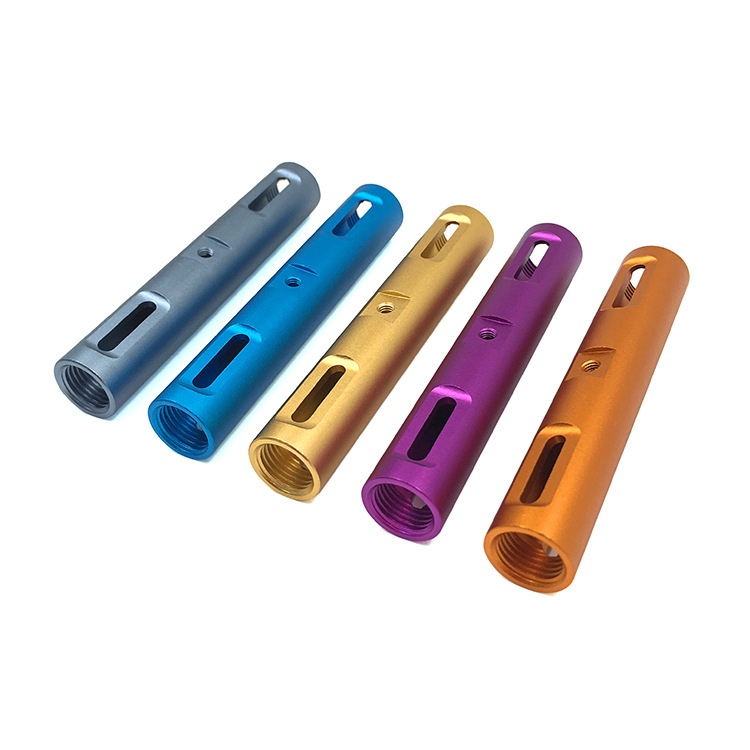
The first thing we do is take a knife to it
When a hard-anodised batch comes back from the finisher, before anything is measured, someone drags a blade edge across a corner of one part. Type II marks — you get a bright scratch straight through to the metal. A proper Type III coating does not: the blade skates, and what little mark there is wipes off.
That is not an acceptance test and we would not put it on a report. It is a five-second sanity check that tells us whether we are looking at a real hardcoat or a thick decorative anodise sold as one, which is a substitution that happens more often than buyers expect. The actual acceptance is coating thickness and appearance against what the drawing calls for, on the parts and on the coupon that runs with them.
Coating thickness measurement and any hardness testing are done by an independent testing house, not in our workshop. How we inspect →
What actually differs, in the words your drawing uses
Both are anodising: an aluminium oxide layer grown out of the part itself, not plated on. The difference is the bath — Type III runs colder and at much higher current density, which grows a denser, thicker, harder layer. Everything else on this list follows from that.
| Type II (decorative / protective) | Type III (hardcoat) | |
|---|---|---|
| Specification | MIL-A-8625 Type II | MIL-A-8625 Type III |
| Typical thickness | 5–25 µm (0.0002–0.0010 in) | 25–75 µm (0.001–0.003 in); 50 µm / 0.002 in is the usual default if the drawing does not say |
| Dimensional growth | Small enough to ignore on most parts | About half the coating thickness grows outward per surface — the other half eats into the base metal |
| Wear resistance | Will scratch and wear through on a sliding face | The reason you are reading this page |
| Colour | Full colour range, consistent and repeatable | Class 1 undyed comes out grey to bronze. Class 2 is dyed, and the range is wider than most shops admit — black, red, green, blue, purple, orange, gold and bronze are all achievable. They read deeper and richer than the same dye on Type II, and the thicker the coating the darker the result |
| Colour consistency | Good | Varies with alloy, thickness and bath temperature. We match within a batch; we do not promise a match across batches or across alloys |
| Sharp edges | Tolerates them | Chips and builds unevenly on a sharp corner. Edges need breaking |
| Cost and lead time | Lower, faster | Higher, and longer — the bath runs slower and the racking is more careful |
The class is the dye, not the hardness: Class 1 is undyed, Class 2 is dyed. A drawing that says “Type III, Class 2, black, 0.002 in” has told the finisher everything they need.
Five things Type III changes that Type II does not
None of these are difficult. They are just the ones that come back as a first-article problem when nobody thought about them at the drawing stage.
The part gets bigger, and the material gets thinner
Roughly half the coating grows outward from the original surface and half consumes base metal. At the common 0.002 in call-out that is about 0.001 in of growth per surface — so a shaft gains about 0.002 in on diameter and a bore loses about the same. On a sliding fit or a bearing bore that is the whole clearance. Tell us the coating is going on and we machine the part to finish at size after anodising.
Tapped holes close up
A tapped hole shrinks on pitch diameter by about the coating thickness. On a fine thread in a hardcoated part, the mating screw will not start. The two honest fixes are to plug the hole so the coating never goes in, or to tap after anodising. Both are normal; pick one on the drawing rather than leaving it to the finisher.
Sharp edges chip
Hardcoat is hard and brittle, and on a knife-sharp corner it builds unevenly and then flakes at exactly the place a customer runs a thumb. A 0.2–0.3 mm edge break is usually enough. If the part is an EDC or outdoor item that gets handled, this is the difference between a finish that looks used after a year and one that looks chipped after a week.
Colour is available, but it comes out deeper than you drew it
A lot of suppliers will tell you hardcoat only comes in black. That is their line, not a limitation of the process — we have run Type III in red, green, blue, purple and orange as well as black. What is true is that the coating is already grey to bronze before any dye goes near it, so every colour lands deeper and more muted than the same dye on Type II: a red reads oxblood, a blue reads navy. Pastels and bright yellows are not realistic. And the thicker the coating, the darker it goes — at 25 µm you keep more of the colour than at 50 µm, so if the look matters, say so and we will specify the thinner end.
Masking is a real cost, not a footnote
Bearing bores, dowel holes, electrical contact faces, threads, anything that has to stay bare metal — each masked feature is hand work on every piece. Two masked features on a 500-piece order is a meaningful line on the quote. It is worth asking whether the feature can simply be machined after coating instead.
Which aluminium takes a hardcoat well
Type III is far more alloy-sensitive than Type II. Copper and silicon in the alloy are what cause most of the trouble — they do not convert to oxide the way aluminium does, so they leave the coating thinner, patchier or a different colour.
| Alloy | How it takes Type III | What to expect |
|---|---|---|
| 6061 / 6082 | The benchmark. Clean, even, predictable | Grey to bronze undyed, darkening with thickness. Dyes black reliably. If the drawing does not care, this is what we would put it on. Aluminium grades → |
| 7075 | Takes a good hard coating | Comes out noticeably darker and greyer than 6061 on its own. Much commercial “black 7075” is dyed, not natural. Do not expect 6061 and 7075 parts in the same assembly to match |
| 2024 and other high-copper alloys | Workable but harder to control | Copper interferes with the coating. Thinner, less uniform, sometimes a duller finish. Realistic corrosion performance is below 6061 |
| 5052 / 5083 | Good | Even coating; commonly used where forming precedes machining |
| Cast alloys — ADC12, A380, high-silicon die-cast | Poor. We will usually advise against it | Silicon does not anodise. The result is patchy, grey-mottled and thin in places. If a cast part needs wear resistance, look at a different finish route entirely |
Mixing alloys in one visible assembly is the single most common cause of a hardcoat rejection that has nothing to do with the finisher. If two parts have to match, machine them from the same alloy and run them in the same batch.
When Type III earns its cost, and when it does not
Hardcoat costs more than Type II and takes longer. On the right part that is money well spent; on the wrong one it buys you nothing and creates problems. Here is how we split it.
Worth it
- Sliding, rotating or rubbing aluminium surfacesPivots, slides, guides, cam faces — anywhere an aluminium part is being asked to survive contact it would normally lose.
- EDC and outdoor hardwareClips, bodies, bolsters, tool handles, anything that lives in a pocket or a pack. This is where the knife test matters to the end user, not just to us. Knives and EDC →
- Cosmetic parts with a long service lifeA visible aluminium face that has to still look presentable after years of handling. Hardcoat is the finish that gets you there.
- Replacing a steel part with aluminiumWhere you want the weight saving but wear was the reason the part was steel in the first place.
Not worth it
- You need an exact brand colour, or a pastelType III dyes well, but deep. If the part has to hit a specific Pantone, or be a light or bright shade, Type II is the honest answer. Type II anodising →
- Tight-tolerance fits with no allowance leftIf the drawing is already at limit and cannot be re-cut for coating growth, Type III will fight you the whole way.
- Cast or high-silicon partsThe finish comes out patchy and grey-mottled. It will look like a defect even when it is not.
- Cosmetic-only interior partsIf nothing touches it, you are paying for wear resistance nothing will ever use.
Who does the anodising, and what we are responsible for
We do not run an anodising line. Surface finishing is sent out, to plants we have used for years and whose hardcoat we know. We say this on every finish page because a buyer finds out eventually and it is better heard from us.
What that means in practice is that the finisher owns the bath and we own everything around it. We write the specification onto the works order rather than letting it be assumed — type, class, thickness, colour, which features are masked, whether threads are tapped before or after. We machine the part to allow for coating growth so it finishes at the size on your drawing. We inspect the parts when they come back, against the drawing, before they go anywhere near a carton. And if a batch is wrong, it is our problem to put right, not yours to chase.
We are not ISO 9001 registered and we do not claim to be. What we can give you is the coating specification we sent, the parts measured after coating, and an independent test report on coating thickness when the drawing calls for one. How we inspect → · All finishes we arrange →
Common questions
If I do not specify a thickness, what will I get?
Can you match the black on our existing parts?
Is hard anodising the same as hardcoat, Type III, or MIL-A-8625 Type III?
Will it make the part corrosion-proof?
Can you hard anodise material we supply?
Do you have a minimum quantity?
Send the drawing and tell us what the part rubs against
That one sentence usually decides Type II or Type III faster than the drawing does. We will quote the machining and the finish together, and tell you if we think you are specifying the wrong one.