
CNC Machining Polyurethane
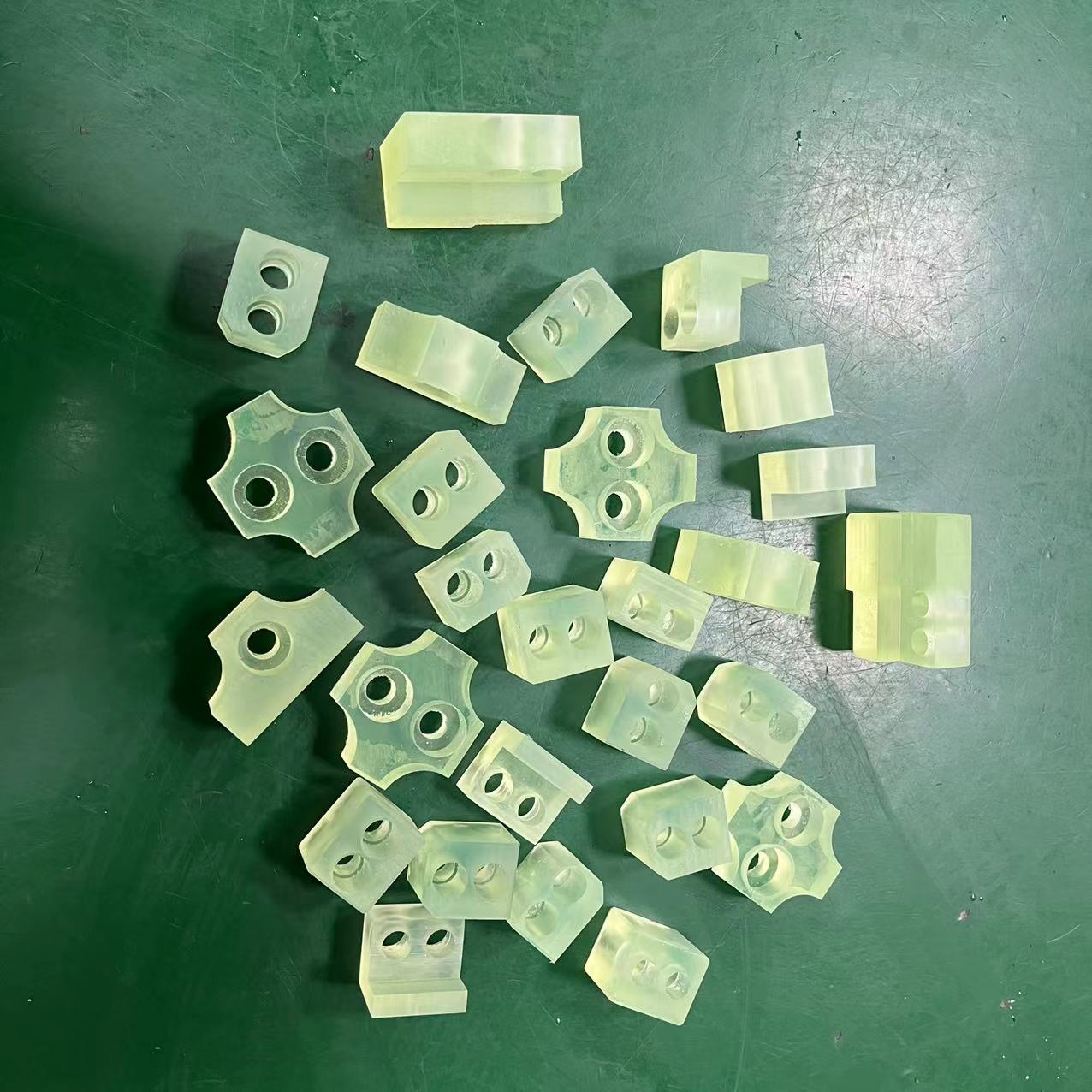
Polyurethane is the material you choose when the part has to absorb something — impact, vibration, load against a delicate surface. It spans an enormous hardness range, from something like a pencil eraser to something close to a rigid plastic, and the hardness you pick changes both what the part does and how it can be machined.
Hardness, not grade
Polyurethane is specified by durometer. Everything else about machining it follows from that number.
| Hardness | Feel | Typical use | Machining |
|---|---|---|---|
| 40–60 Shore A | Soft, like a rubber eraser | Pads, bumpers, gaskets, protective contact surfaces | Deflects badly under the cutter; needs frozen or fixtured approaches |
| 70–90 Shore A | Firm rubber | Rollers, wheels, vibration mounts | Machinable with sharp tooling and light passes |
| 95 Shore A to 60 Shore D | Hard rubber to soft plastic | Wear pads, bushings, drive rollers | The easiest range to machine accurately |
| 70–80 Shore D | Rigid, plastic-like | Structural wear parts, scraper blades | Machines much like a tough plastic |
Soft material, hard problem
Machining polyurethane is a workholding problem more than a cutting one. The material deflects under both clamping pressure and cutting force, so the dimension under the tool is not the dimension you get when the part is released. Sharp tooling, minimal clamping, and support underneath the cut are what make it work.
Below about 80 Shore A, conventional milling becomes impractical for tight tolerances and the sensible routes are moulding, waterjet or a fixtured approach agreed in advance. Above that, polyurethane behaves increasingly like a tough plastic and machines accordingly.
Tolerances are correspondingly wide. A soft polyurethane part cannot hold what an acetal part holds, and a drawing that demands it is describing something that does not exist.
| At a glance | |
|---|---|
| Hardness range | Roughly 40 Shore A to 80 Shore D |
| Best at | Impact absorption, vibration damping, abrasion resistance |
| Machinability | Depends entirely on hardness |
| Tolerances | Wide, and hardness dependent — tell us which dimensions are functional |
| Typical parts | Rollers, wheels, pads, bumpers, wear strips, vibration mounts |
Three notes on polyurethane parts
Give us the durometer
“Polyurethane” on its own does not describe a material. The hardness determines the part, the process and the achievable tolerance.
Say what it is bonded to
Many polyurethane parts are cast or bonded onto a metal core — a roller on a steel shaft, a pad on a plate. Tell us early, because it changes how the part is made rather than how it is finished.
Keep the tolerances honest
Mark the dimensions that must be right. On a soft part, a general tolerance copied from a metal drawing is not achievable and not necessary.
Finishes that work on polyurethane
Polyurethane parts are used as machined or cast. Coatings do not apply.
Finishing is done by partner shops we specify and inspect for — we do not run plating or coating tanks ourselves. How we handle finishing →
Send the drawing and the durometer
Send the drawing and the grade, or the drawing and a sentence about what the part has to survive. You get a price, a lead time, and an engineer’s note on anything that will fight the tolerances.