
EDM machining · Design & purchasing guide
The outside of a part may be straightforward. One narrow slot, deep cavity or tight internal corner can decide how the whole job is made.
That is where electrical discharge machining becomes useful. The important question is which feature needs it, how the electrode reaches that feature and what the finished part must do.
This guide compares wire EDM and sinker EDM from the drawing outward: geometry, materials, corner radii, tolerances, heat treatment, surface integrity and cost. It also explains what to send with an RFQ so two suppliers are quoting the same job.
In this guideShow contentsHide contents
The quick answer: look at the feature first
Wire EDM is usually the first process to consider for an accessible profile that passes through the workpiece. Sinker EDM is usually the first process to consider for a blind cavity or recessed detail that can be reached by a shaped electrode. Conventional milling remains a strong option when a rotating cutter can reach the geometry economically.
That is a starting point, not a complete process plan. Material, thickness, corner radius, inspection access and quantity can change the route. A through-slot that opens onto an edge is different from an enclosed profile. A shallow pocket with generous radii is different from a narrow cavity with a floor and delicate ribs.
| Decision | Wire EDM | Sinker EDM |
|---|---|---|
| Electrode | Continuously fed wire | Shaped electrode, commonly copper or graphite |
| Typical geometry | Through-profiles, slots, punches and die openings | Blind cavities, deep recesses and local details |
| Access to plan | Wire entry and a continuous cutting path | Electrode approach, withdrawal and flushing |
| Custom electrode machining | No cavity-shaped electrode | Usually required |
| Internal corners | Limited by wire size, spark gap and cutting conditions | Limited by electrode geometry, spark gap and wear |
| First cost question | How much profile must be cut, through what height? | How much electrode work and cavity erosion are required? |
What EDM machining actually does
Electrical discharge machining removes material through controlled electrical discharges across a small gap. The workpiece must conduct electricity, and a dielectric fluid supports the process and carries debris away. There is no rotating cutting edge shearing chips from the part.
For the buyer, the useful distinction is how the electrode reaches the feature. The word “EDM” on a quotation does not tell you whether the supplier is planning wire cutting, die sinking or another EDM operation. Ask which feature requires the process and how it will be inspected.
When wire EDM is the better fit
Wire EDM guides a thin electrode along a programmed path. It is well suited to profiles such as tooling inserts, narrow through-slots and accurately shaped openings. Machines with suitable guide-axis control can also cut tapers; the available geometry depends on the machine and the workpiece.
Plan how the wire enters
An open profile may be approached from an outside edge. An enclosed internal profile normally needs a through start hole so the wire can be threaded into the cut. That hole belongs in the process plan: it must not damage a surface or leave an unwanted opening in the finished part. Separate enclosed features may need separate starts.
Consider a plate with several isolated openings. Quoting only the total outline length misses the work needed to prepare and thread those openings. In an RFQ, show which holes already exist, which surfaces are finished and whether the supplier is receiving raw stock or a partially machined component.
Think about access above and below the part
A small feature on a bulky component can be less straightforward than the same feature in a flat plate. Clamping, wire-guide clearance and the shape around the cut all matter. Send the complete model rather than a cropped screenshot of the slot.
When sinker EDM makes more sense
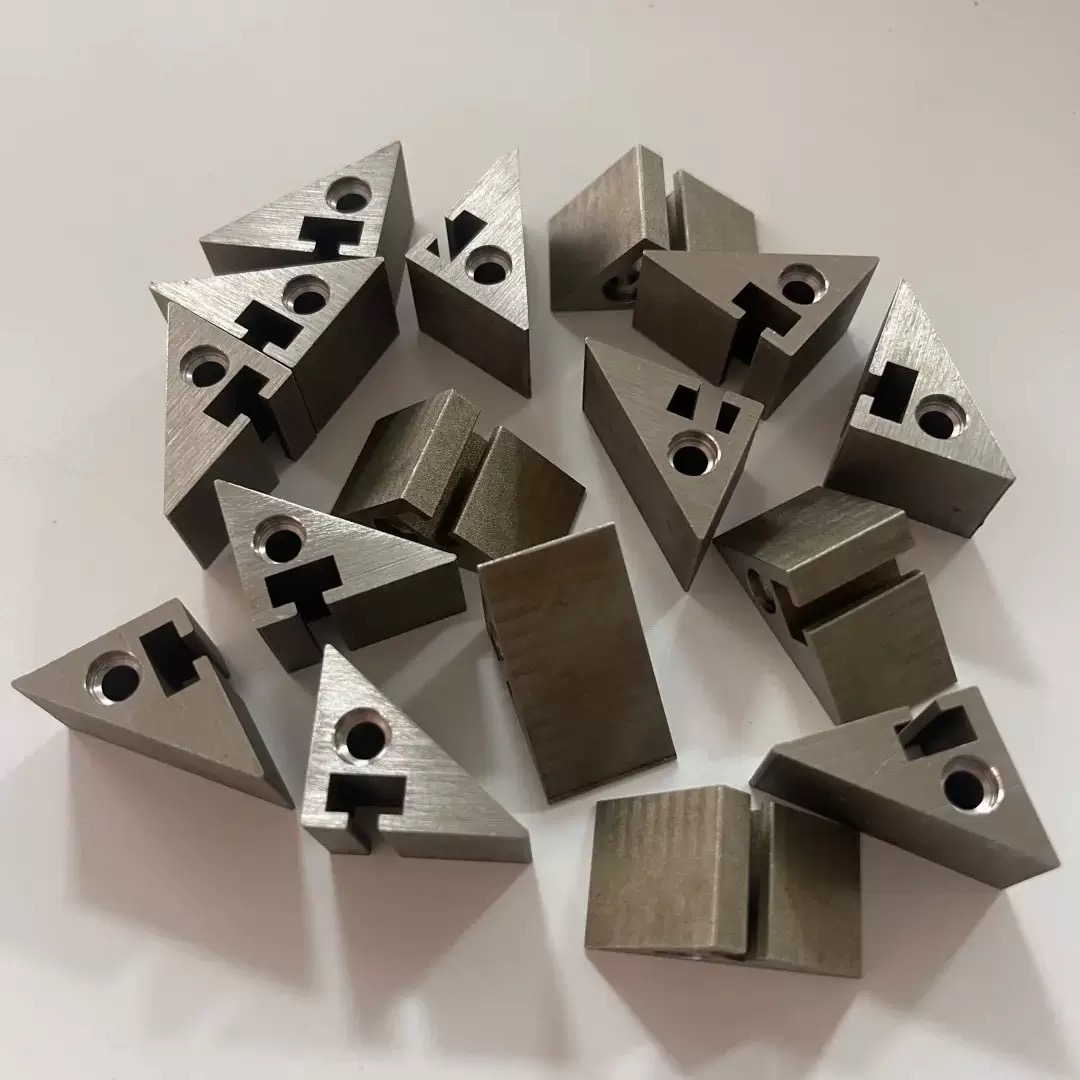
Sinker EDM, also called die-sinking or ram EDM, uses a formed electrode to create a recessed feature. It is useful for difficult cavity details in conductive materials, including hardened parts. The electrode approaches the workpiece while the machine controls the discharge gap.
A blind slot illustrates the difference. A wire cannot simply pass through it while leaving the specified floor intact. A shaped electrode may be able to form it, provided the electrode can enter, withdraw and allow the process to operate reliably.
The electrode is part of the manufacturing job
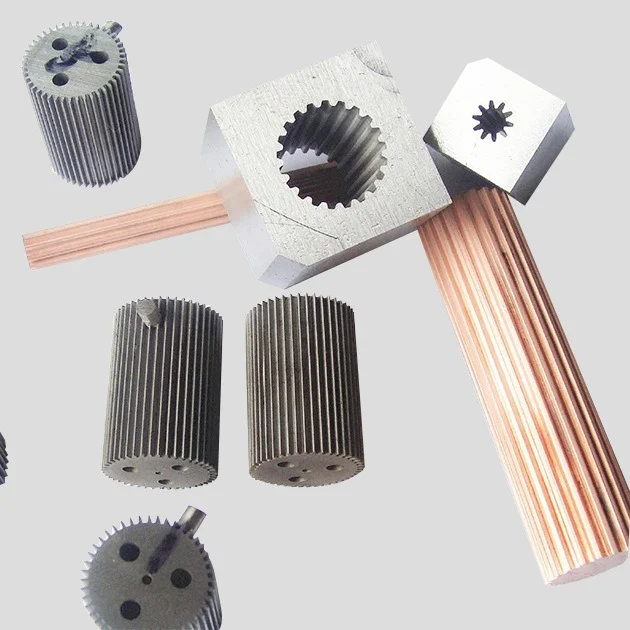
The supplier must plan the electrode material, shape and size compensation. Copper and graphite are common choices; the right choice depends on the application. Makino identifies electrode selection and reduction size as important productivity decisions.
For a purchasing team, this means the electrode line on a quote deserves an explanation. Ask whether it covers design, manufacture and any finishing electrodes; whether it is a one-time charge for the drawing revision; and how repeat orders will be priced. Do not assume an electrode is reusable indefinitely or that every design change leaves it suitable.
EDM or milling? Often the economical answer uses both
Makino notes that sinker EDM generally removes material more slowly than conventional milling, while remaining useful for small, deep features that are difficult to mill accurately. That supports a practical quoting question: how much of this component actually needs EDM?
A large accessible pocket with generous internal radii may be a milling job. A similar pocket with a small local detail may justify milling the accessible material first and reserving EDM for that detail. On another part, heat treatment and the final fit may make a different sequence more appropriate.
When comparing quotations, ask for the proposed sequence in plain language. “Mill the body, prepare the datums, then EDM the critical opening” gives you more useful information than a quotation that assigns one process to the entire component.
Design freedom is valuable here. If a larger corner radius or an approved corner relief would let the mating component seat correctly, ask the engineer to compare that option. The purpose is to preserve the function while giving the supplier a less demanding manufacturing route. See our machining cost guide for the other drawing decisions that affect price.
Which materials can be EDM machined?
Electrical conductivity is the basic eligibility test. Hardened steels, titanium, copper and brass are among the material families used in EDM. Ordinary unfilled engineering plastics are not conventional EDM workpieces. A material name alone, however, does not establish the cutting conditions.
Entegris explains that the work material, electrode, machine and process priorities must be considered together. Thermal properties and material composition influence the response to discharge energy.
| Material family | Information to put in the RFQ |
|---|---|
| Tool steel | Exact grade, heat-treatment condition and required final hardness |
| Stainless steel | Exact grade, service environment and any surface-treatment requirements |
| Titanium | Grade, critical surface requirements and the applicable drawing specification |
| Copper or brass | Alloy designation and the functional requirements of the cut surface |
| Carbide or a specialty conductive material | Full grade or composition information and any restrictions on the EDM process |
A useful request is “quote this grade in this condition, with these acceptance criteria.” “It is metal, so EDM should work” leaves too much unresolved.
Can EDM make a perfectly sharp internal corner?
Specify a measurable radius rather than assuming that EDM means a zero-radius internal corner. Wire EDM leaves an internal radius related to the wire size and discharge gap. An outside corner and an inside corner are different geometrical problems.
A simple illustration helps: a 0.25 mm diameter wire already has a radius of 0.125 mm. An internal turn cannot be evaluated from the centerline alone; the effective cutting gap and actual machining conditions also have to be included. This illustration is not a promised minimum radius.
Sinker EDM can make very small internal corners, but electrode detail, the discharge gap and wear still matter. For perspective, Makino publishes a finite minimum internal corner radius even for its specialist EDAC1 machine. That is a specification for that particular machine, not a capability claim for GY or every EDM shop.
On a drawing, identify the maximum allowable internal radius and explain whether a mating part must seat into the corner. If the radius is only cosmetic, say so. If the feature is a fit, share the mating geometry or a section through the assembly. Those details are more useful than adding “sharp” beside an otherwise undefined corner.
What determines EDM accuracy?
A positioning specification for a machine is not an acceptance report for your component. The question to ask is whether the supplier can hold the specified geometry on your material, feature height and setup, using the proposed finishing route.
Wire EDM finishing passes, often called skim cuts, can improve accuracy and surface finish. Wire behavior and material movement can still affect the result. A tight opening measured at one face does not by itself establish the geometry through the full height.
For a critical fit, define what must be controlled: opening size, profile, straightness, taper, position relative to mounting holes, or some combination. State the datums and the inspection locations. If a probe cannot reach a narrow recess, agree how that feature will be verified before placing the order.
A hypothetical requirement such as ±0.005 mm should trigger a discussion about the particular feature and inspection method. It should not turn into a general promise that every dimension on the component will be held to the same value. Our quality and inspection page explains how we approach drawing-based checks.
Why heat treatment and residual stress still matter
EDM can be useful on material that is already hardened. Finishing a critical profile after heat treatment avoids putting that finished profile through the earlier heat-treatment cycle. It does not guarantee that the remaining workpiece is free from residual stress.
Removing material can release existing stress and allow the component to move. Reliable EDM discusses material movement even after stress relief, which is one reason the sequence of roughing and finishing deserves attention.
For a long, thin component or an opening that removes a substantial portion of the original section, send the stock condition and heat-treatment history with the RFQ. Ask which dimensions will be finished before hardening, which will be finished afterward and where allowance is needed.
A practical purchase-order check is to compare the drawing revision, material condition and final inspection stage across the quote and inspection plan. Agreement about the finished dimension is only useful when everyone also agrees when it is being measured.
Surface finish and recast layer are separate requirements
An EDM surface is created thermally. Some molten material can resolidify on it as a recast layer, and material below the surface can also be affected by the heat. The condition depends on the material and discharge process.
Surface roughness describes the texture of the surface. It does not, by itself, prove the absence of recast material or satisfy a separate metallurgical requirement. A smooth-looking part and an acceptable fatigue-critical surface are different acceptance questions.
Write the finish parameter and units on the drawing. Ra, Rz and an EDM texture designation should not be treated as interchangeable numbers. Identify the surfaces that need the specified finish; applying the same demanding requirement to every face may change the quoted route.
Where the application requires control of recast layer, cracking, surface damage or subsequent removal, provide the governing specification and verification method. Discuss finishing, removal allowance and inspection together. Polishing a critical corner after machining may also change its geometry, so acceptance should address the final condition.
Ask the supplier to confirm how the requested surface condition will be achieved on this part. A statement about what a machine can achieve under other conditions is not enough.
What actually drives the cost of EDM machining?
The best cost discussion starts with the difficult features. Before negotiating the total, identify which requirement adds electrode work, finishing time, setup or inspection. Then decide whether that requirement is essential to the part.
Wire EDM: profile length, height and access
More cutting length through a greater workpiece height generally means more cutting work. Starts, restricted access and the finishing route also belong in the estimate. Do not compare two jobs only by their outside dimensions.
A useful buying question is: “Which feature controls the cycle time?” A relatively small enclosed opening may deserve more discussion than a long accessible outside edge. Ask for separate pricing of genuine alternatives, such as the present radius versus a larger allowable radius.
Sinker EDM: count the electrode work as well as the burn
Entegris identifies electrode manufacture, wear, detail, depth, finish, tolerance and quantity as connected planning factors. The lowest-cost electrode material does not automatically produce the lowest-cost finished component.
Ask whether the quote includes all electrodes needed for the stated finish and tolerance. If you have a family of similar parts, send the family together and ask what can be shared. If a cavity will change after a trial assembly, discuss the revision plan before the electrode is made.
Flushing and geometry can make similar parts behave differently
Mitsubishi Electric explains how changes in workpiece shape and nozzle distance affect wire EDM stability and settings. Its discussion also identifies a productivity tradeoff when thinner wire is used for finer corners.
For procurement, the implication is to send the full component geometry and ask the supplier to identify access concerns. A screenshot that hides a step, wall or obstruction may lead to a quotation that needs to be revisited.
Compare quotations against the same acceptance criteria
Check material condition, corner radius, finish, critical dimensions, inspection scope and any post-processing. A cheaper quote may simply describe a different job. Conversely, a more expensive quote may include a finish or report you do not need.
Specify your batch quantity and expected repeat demand. Ask suppliers to separate genuinely reusable setup or tooling charges from recurring part costs. That gives you a better basis for comparing the first order with the next one.
A drawing example: the same slot, three different routes
This is a hypothetical design example, not a customer case study or a statement of measured GY performance.
Imagine a tooling plate that needs a narrow locating feature. In the first version, the slot is open at both faces and the wire has a clear path. Wire EDM is a candidate, subject to the required radius, size and material.
In the second version, the drawing adds a floor. The feature is now blind. The original wire-cutting route no longer produces the specified shape; sinker EDM becomes a candidate if a suitable electrode can reach it.
In the third version, the designer permits a wider slot and larger internal radii. A milling cutter may now be practical. The engineer should compare that route with EDM before choosing the process.
The lesson is to explain what the slot does. Does it locate a mating piece, retain a spring, provide clearance or carry a load? If the supplier knows which surfaces perform the function, there is a better chance of improving the manufacturing route without changing the intent.
What to send for an accurate EDM quotation
Send a 3D model and a dimensioned 2D drawing together. The model describes the shape; the drawing communicates the acceptance requirements. A useful RFQ also answers the following questions.
- What is the material? Include the exact grade, supplied condition, hardness and any heat treatment already completed or still required.
- Which features are critical? Mark the functional dimensions, datums, allowed internal radii and required relationship to existing holes or faces.
- What access is available? Identify blind features, start-hole restrictions and any surfaces that must remain untouched.
- What surface condition is required? State roughness, texture, recast-layer or other surface requirements where they apply.
- What arrives at the EDM operation? Raw stock and a nearly finished component are different quoting situations. Show existing machining, coatings and finished datums.
- What is the order size? Give prototype quantity, production quantity and expected repeat demand separately.
- What must the report demonstrate? State required dimensions, inspection methods or acceptance standards before production.
- When do you need the parts? Distinguish the required dispatch date from the required arrival date.
If the part is confidential, arrange the NDA before sending files. If you are unsure which process to specify, request a DFM review and describe the feature’s function instead of guessing the machine.
Frequently asked questions
Is wire EDM more accurate than sinker EDM?
There is no universal ranking for every component. Compare the required feature, material, geometry, finishing route and inspection method. Each process has applications where it is a better fit.
Can wire EDM make a blind pocket?
Standard wire cutting needs a path through the workpiece. A pocket with a retained floor normally calls for another approach, such as milling or sinker EDM, depending on its geometry.
Does every wire EDM job need a start hole?
No. An open cut can start from an accessible edge. An enclosed internal profile normally needs a through opening for threading; its location must be included in the process plan.
Can EDM cut hardened steel?
Yes, hardened conductive steel is an established EDM application. Provide the grade, hardness and material condition so the supplier can plan the operation.
Are EDM parts guaranteed to stay straight?
No. The process avoids conventional cutting-tool forces, but residual stress, geometry, fixturing and the machining sequence still need to be considered.
Can I specify a zero-radius internal corner?
Use a measurable maximum radius based on the part’s function. Wire size and spark gap matter in wire EDM; electrode detail, gap and wear matter in sinker EDM.
Will a fine surface finish remove all recast material?
A roughness requirement alone does not establish that. If surface-layer control is necessary, specify its acceptance criteria and agree the machining, post-processing and verification route.
Should I choose the EDM process before requesting a quote?
You can state a preferred process, but it is often more useful to send the drawing, quantity and functional requirements and ask for a proposed manufacturing sequence.
How GY Machining handles EDM work
GY Machining runs six sinker EDM machines in our own shop in Dongguan. Wire EDM is handled through a long-term partner with slow-, medium- and fast-wire equipment. We state that arrangement clearly so you know where the work is done.
Send the drawing and tell us which features matter in assembly. We will review whether the job suits wire EDM, sinker EDM, milling or a combination, and confirm the achievable requirements for the specific component before production.
Have a corner, slot or cavity that is difficult to machine?
Send the STEP model, drawing, material and quantity. Ask us to compare the practical process options and identify the features driving the quote.
Request an EDM quotation →Email Eileen: 1@gymachining.comRelated reading: GY wire & sinker EDM services · CNC milling · Machining lead time.