
Laser Cutting Services
Fibre laser cutting of steel, stainless and aluminium sheet — brackets, mounting plates, cover panels, shims and blanks for machining — cut at a partner plant we have used for years, then checked, machined where needed and shipped by us together with the CNC parts they belong to.
The laser is not in our building. The inspection, the machining and the order are.
GY is a machining shop. Laser cutting is done by a sheet metal plant we have worked with for years and whose edge quality we know — we say this up front because a buyer finds out eventually, and it is better heard from us.
What you get from us is one supplier and one order. We turn your model into a flat pattern and check it for laser rules before anything is cut, we measure the first sheet and every batch that comes back, we drill, ream, tap and mill whatever the laser cannot hold, and we ship it all on one date with one packing list. If a laser-cut bracket does not fit the housing we milled, that is our problem to fix — not a conversation between three companies.
- Drawing review, flat pattern, DFMGY
- Laser cuttingPartner plant
- Bending, welding, hardwarePartner plant
- Drilling, reaming, tapping, millingGY, in-house
- Deburr, incoming inspectionGY
- Powder coat, plating, anodisingPartner plants
- Assembly, packing, shipping, invoiceGY
Laser cut it, machine it, or both
Most flat parts have three ways to be made. The cheapest one depends on the thickness, the tolerances and the features that are not flat — and because we run the milling machines ourselves, we can quote all three and tell you which one wins.
| Laser cutting only | Laser-cut blank + CNC machining | Milled from plate | |
|---|---|---|---|
| Typical parts | Brackets, cover plates, panels with cut-outs, shims, spacers, gaskets in metal | Mounting plates with tapped holes, base plates with pockets, flanges with reamed bores, thick brackets with counterbores | Plates where every face and edge carries a tolerance, thick blocks, parts thicker than the sheet range |
| Profile tolerance | ±0.1 – 0.2 mm | ±0.1 – 0.2 mm on the outline; ±0.01 – 0.05 mm on the machined features | ±0.01 – 0.05 mm everywhere |
| Holes | Fine for clearance holes larger than the sheet thickness; small holes come out slightly tapered | Laser-cut undersize, then drilled, reamed or tapped on our machines — round, square to the face, to size | Drilled, reamed or tapped in the same setup as the rest |
| Pockets, threads, counterbores | Not possible — the laser only cuts through | Yes, added in-house after cutting | Yes |
| Cost, 1 piece | Lowest — no tooling, minutes of cutting | Low — one short machining setup on a near-net blank | Highest — most of the plate is turned into chips |
| Cost, 100 pieces | Almost the same per piece as one | Falls further: blanks nest on one sheet, fixtures hold several at once | Falls with batch size, but material and cycle time stay |
| Edge finish | Laser edge: fine striations, small heat-affected zone, dross removed | Laser edge on the outline, machined finish where it matters | Machined finish all round |
Rule of thumb: if the outline is loose and the holes are tight, laser-cut the blank and let us machine the holes. If everything on the part is tight, mill it.
What the partner plant does, and what we check
Flat pattern and laser rules
We take your STEP or DXF, produce or check the flat pattern and run it against the rules below: hole size against thickness, slot widths, web widths, kerf and nesting. Anything the laser cannot hold is flagged as a machining operation before we quote, not after the parts arrive.
First sheet, then the batch
The partner plant cuts the first sheet; we measure outline dimensions and hole positions against the drawing before the batch runs. Every batch is checked again when it comes back — dimensions, edge quality, dross and flatness.
Machining in our own shop
Reamed bores, tapped holes, counterbores, countersinks, pockets and machined edges are done on our machining centres after cutting. This is the part most laser shops cannot offer, and it is why a laser-cut blank from us arrives ready to bolt on.
Deburr, finish, ship together
Burrs and dross removed, then powder coating, plating, anodising or brushing at the same partner plants that finish our machined parts — so a laser-cut cover and a milled housing come back in the same colour. One order, one date. Finishes →
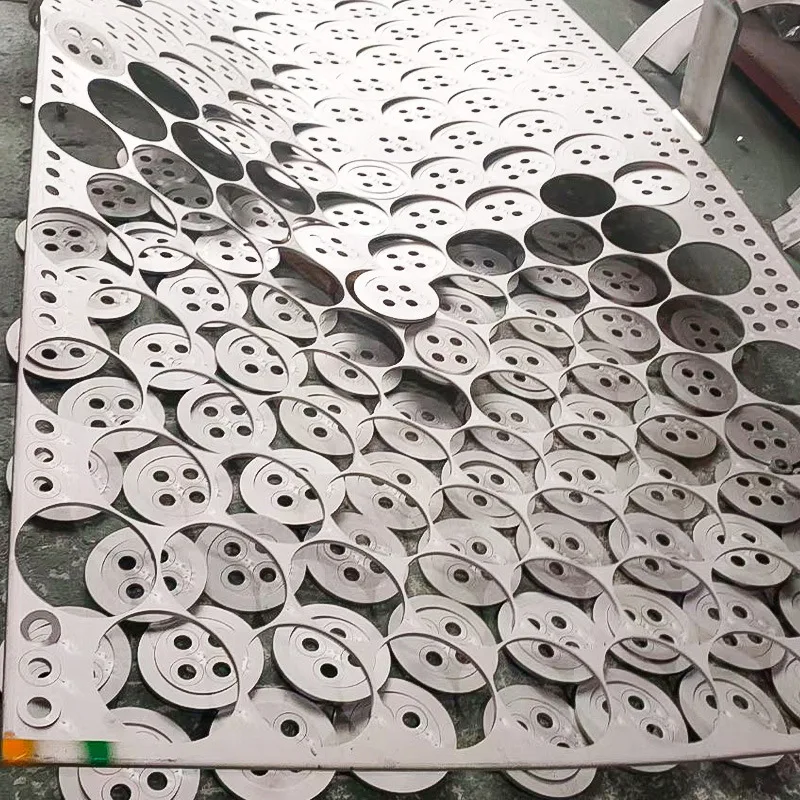
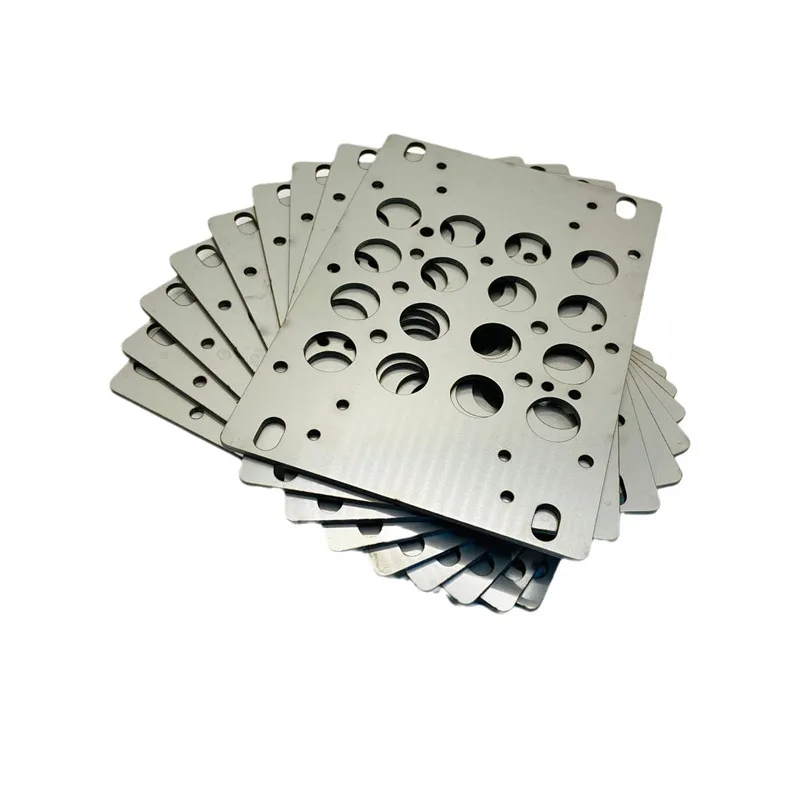
Left: the partner plant’s DNE 1530F fibre laser (1.5 × 3 m bed) cutting nested brackets from steel plate. Middle: stainless discs still sitting in the sheet skeleton after cutting — tight nesting is where the material saving comes from. Right: a batch of laser-cut steel plates after deburring. Need bending, welding or hardware as well? Sheet metal fabrication →
Sheet materials and thicknesses
Typical ranges for the fibre laser at our partner plant. Thicker sheet is often possible — ask, and we will confirm before quoting.
| Material | Typical thickness | Grades we see most | Notes |
|---|---|---|---|
| Mild and carbon steel | 0.5 – 12 mm | Q235 / S235 / A36, SPCC, 1010 | Oxygen-cut edges carry a thin oxide skin; specify a nitrogen cut if the part will be powder coated or welded without cleaning. |
| Stainless steel | 0.5 – 8 mm | 304, 316, 316L | Nitrogen cut, oxide-free edge. Brushed or bead-blasted afterwards if the surface shows. |
| Aluminium | 0.5 – 6 mm | 5052, 6061, 1050 | Small burr on the underside is normal and removed at deburr. Anodising after cutting is routine. |
| Brass and copper | On request | H62 / C26000, C11000 | Reflective metals — thin gauges only. For thicker brass and copper parts we machine from plate instead. |
| Galvanised and pre-coated sheet | On request | — | Cut edges lose the coating; we say so on the drawing review and suggest post-plating where it matters. |
Plastics, acrylic and wood are not cut on the fibre laser. Flat plastic parts — Delrin, nylon, PEEK, PTFE — we machine in-house. Plastic machining →
Rules we check your drawing against
| Feature | Guideline | Why |
|---|---|---|
| Hole diameter | ≥ 1 × sheet thickness for a laser-cut hole | Smaller holes come out tapered and rough. We cut them undersize and drill or ream in-house instead. |
| Slot width | ≥ 1 × sheet thickness | Narrow slots trap the melt and the edge quality drops. |
| Hole to edge, hole to hole | ≥ 1 × sheet thickness | Thin webs overheat and distort; on thicker sheet they can burn through. |
| Inside corners | Effectively sharp (radius about 0.1 – 0.2 mm) | The beam is narrower than any end mill. If a machined part must sit in the corner, add clearance rather than asking for R0. |
| Kerf | 0.1 – 0.3 mm depending on thickness | Compensated in the cutting program; you draw the finished size. |
| Tolerance on cut features | ±0.1 – 0.2 mm | Tighter figures on a flat part mean a machining operation — tell us which dimensions actually matter. |
| Tapped holes | Cut at tap-drill size, tapped after | Threads need a round hole at the right size; the laser gives neither in thin material. |
| Countersinks and counterbores | Machined after cutting | The laser only cuts through. Draw them; we add the operation to the quote. |
| Flatness | State it if it matters | Thin sheet can move after cutting, thick plate can arrive with a bow; we flatten or machine the face if the drawing calls it out. |
| Marking | Part numbers and orientation marks can be laser-etched during cutting | No tooling, and legible on bare or plated metal. Powder coat fills an etch in — for coated parts we engrave after coating instead. |
Common questions
Is the laser cutting done in your own shop?
What tolerance can I expect?
Minimum quantity?
Which is cheaper for a thick plate part — a laser-cut blank or milling from solid?
What files do you need?
Do you deburr the parts?
Can you laser-cut plastic or acrylic?
If a laser-cut blank will save you money, we will say so.
DXF, STEP or PDF. We quote laser cutting, machining and finishing as one line each, so you can see where the cost sits — and one date for all of it.