
Electroplating and Electroless Nickel
Plating puts a layer of a different metal on your part — zinc for cheap corrosion protection, nickel for wear and appearance, chrome for hardness and shine, electroless nickel for parts with bores and internal features. All of them add thickness, and where that thickness lands is the difference between the four.
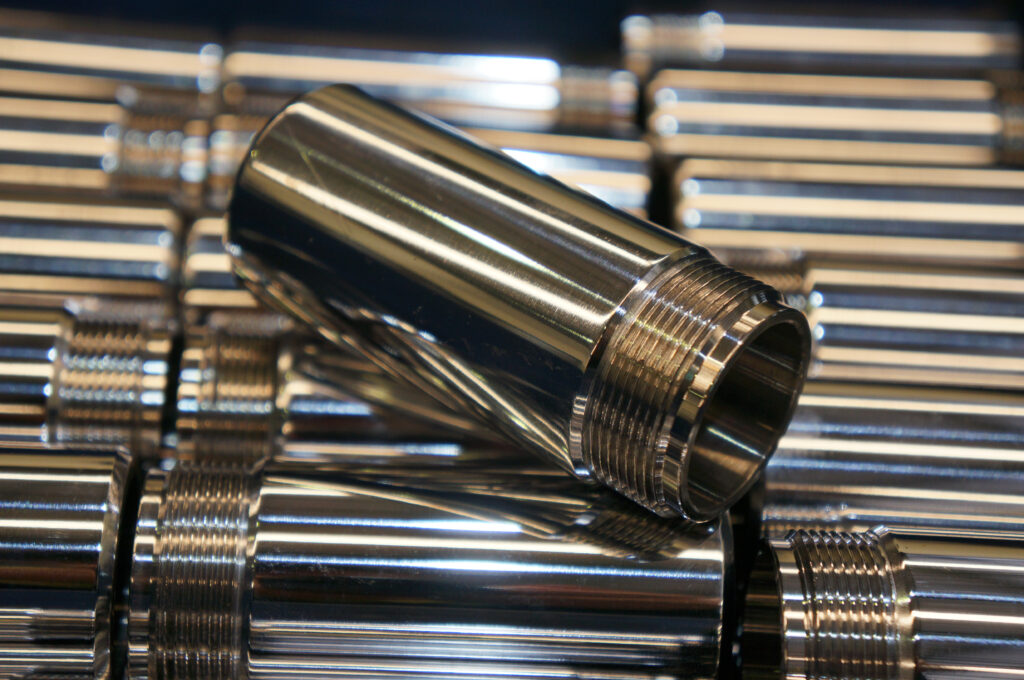
Four processes that people call by one name
Zinc plating is the low-cost corrosion finish for steel fasteners, brackets and hardware. Usually 5–25 µm, often with a clear, blue or yellow passivate over it. It protects sacrificially, which means it corrodes instead of the steel underneath.
Nickel and chrome plating are harder and brighter, used where the part is seen or wears. Both are electroplated, and electroplating follows the electric field: it builds up thicker on edges and corners and goes thin — sometimes to almost nothing — down a deep bore or in a blind hole.
Electroless nickel is the one worth knowing about. It is deposited chemically rather than electrically, so it lands at the same thickness everywhere, including inside bores, threads and internal passages. Commonly 5–50 µm. It costs more than electroplating, and on a part with internal features it is usually the only sensible answer.
One warning that matters on hardware: plating high-strength steel can drive hydrogen into the metal and make it brittle. Where that applies the parts are baked after plating. If your part is a high-strength fastener or a spring, tell us and it will be specified.
| At a glance | |
|---|---|
| Process type | Electrolytic (zinc, nickel, chrome) or chemical (electroless nickel) |
| Materials | Steel, stainless, brass and copper; electroless nickel also on aluminium |
| Typical thickness | 5–25 µm electroplated · 5–50 µm electroless nickel |
| Effect on dimensions | Adds thickness; electroplating builds up on edges and thins in bores, electroless nickel is even |
| Threads | Usually need a plating allowance machined in, or masking |
| High-strength steel | Bake after plating to relieve hydrogen embrittlement |
| Typical parts | Fasteners, shafts, hydraulic and pneumatic bodies, tooling, hardware |
When it is the right finish, and when it is not
Choose it when
- —Steel parts that must not rust and are not painted
- —A wearing surface that needs hardness on top of a tough core
- —Parts with deep bores or internal passages (electroless nickel)
- —A bright decorative metal finish that will not fade
Choose something else when
- —The part is aluminium and anodising would do the job more cheaply
- —A tight tolerance cannot absorb the added thickness and cannot be masked
- —You need colour beyond the metallic range — powder coating is better
What we need on the drawing
Plating is the finish where drawing detail pays for itself most directly, because the thickness is a dimension.
Which plating, and the standard
Zinc, nickel, chrome or electroless nickel, plus any standard or class the drawing works to. Electroless nickel also has a phosphorus content that changes hardness and corrosion resistance — tell us if it matters.
Thickness, and where it is measured
A thickness on a flat face is not the same as a thickness inside a bore. If a dimension has to be held after plating, say so and we will machine undersize to suit.
Threads and fits
State whether threads are plated, masked, or cut oversize to allow for plating. This is the single most common plating rejection we see.
Masking and contact points
Every plated part is held somewhere, and that contact point shows. Tell us which faces must be perfect and we will tell the finisher where to rack it.
Specified by us, applied by a partner, checked when it comes back
We machine in house and we do not run plating or coating tanks — plating is done by finishing shops in the Dongguan area that we have used for years. We write the specification, they receive parts and that specification and nothing else, and we inspect what comes back before it goes anywhere near your order.
Your drawing does not travel with the parts. What happens to your files → · Finishing is quoted as its own line, never hidden in the part price. How a machined price is built →
Tell us what the part has to survive
Send the drawing with the finish you have in mind, or with none at all and a sentence about where the part lives. You get a price, a lead time, and a note on anything in the finish that will fight your tolerances.