
Anodising for Aluminium Parts
Anodising is the default finish for machined aluminium, and the one that causes the most arguments — because it is a coating that grows out of the metal, it changes your dimensions, and its colour depends on the alloy underneath. Here is what Type II and Type III actually do, and what has to be on the drawing before we order it.
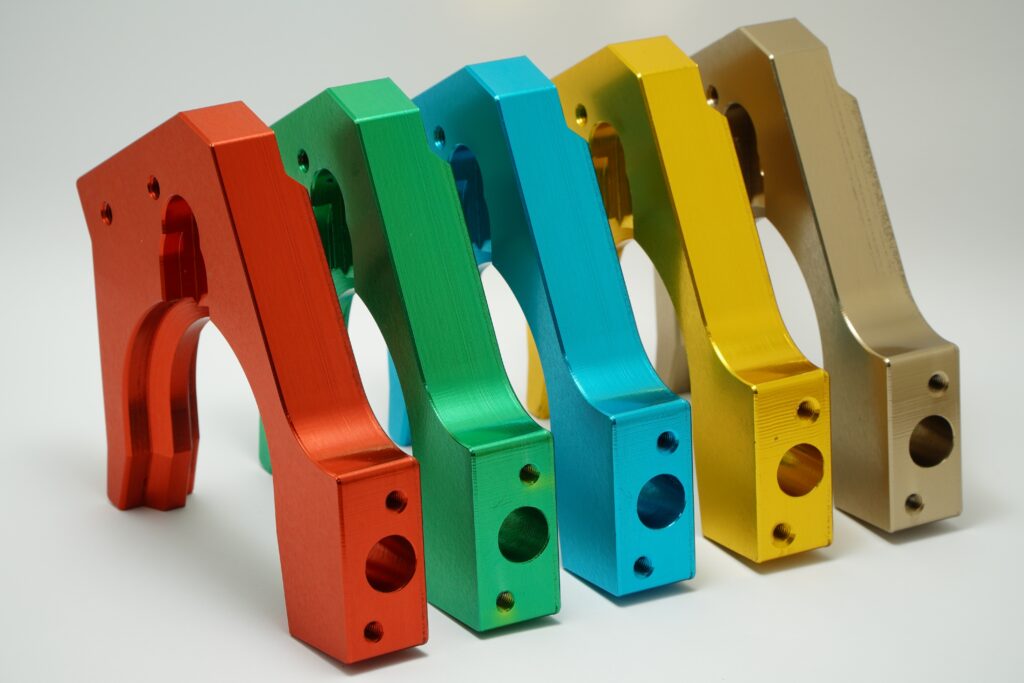
A controlled oxide layer, grown out of the aluminium itself
Anodising is an electrochemical process that converts the surface of the aluminium into a hard, porous aluminium oxide. It is not paint and it is not plating: the layer is grown from the metal, which is why it cannot chip off in flakes the way a coating can. The pores are then dyed, if a colour is wanted, and sealed.
Because the oxide grows both into and out of the original surface, roughly half the coating thickness ends up outside where the metal used to be. On a clearance hole nobody notices. On a bearing bore, a sliding fit or a thread, it is the difference between a part that works and a part that goes back.
Type II is the normal decorative and corrosion finish, usually 5–25 µm, available clear or dyed in a wide range of colours. Type III, called hard anodising, is thicker — commonly 25–50 µm — much harder, and used where a surface has to survive wear rather than look good. Type III colours are limited and always come out dark, from grey to near black, whatever dye is used.
| At a glance | |
|---|---|
| Process type | Electrochemical conversion coating |
| Materials | Aluminium alloys; titanium anodises too, but colours come from oxide thickness rather than dye |
| Typical thickness | Type II 5–25 µm · Type III 25–50 µm |
| Effect on dimensions | About half the thickness grows outward from the original surface |
| Colours | Clear, black and a wide range of dyes on Type II; dark greys and blacks only on Type III |
| Electrical | The oxide is an insulator — earth points and grounding faces must be masked |
| Typical parts | Enclosures, heat sinks, knife scales, brackets, camera and drone parts, front panels |
Type III hard anodising: when an aluminium part has to behave like a steel one
Type II makes an aluminium part look finished and stops it corroding. Type III does something different in kind — it grows a thick ceramic oxide into the surface that resists wear and abrasion, so a sliding, rubbing or load-bearing aluminium part can survive service that would otherwise force you into steel. It is the finish that changes what the material can be used for, and it is the one we most often suggest on parts that are wearing out too early.
| Type II — standard anodising | Type III — hard anodising | |
|---|---|---|
| Standard reference | MIL-A-8625 Type II | MIL-A-8625 Type III |
| Purpose | Corrosion resistance and colour | Wear and abrasion resistance |
| Typical thickness | 5–25 µm | 25–50 µm, and thicker where the drawing calls for it |
| Growth on the part | About half the thickness grows outward | About half again, and on a thicker layer — so it must be on the drawing |
| Hardness | Harder than bare aluminium | Substantially harder — a ceramic oxide, not a coating |
| Colour | Clear plus a wide range of dyes | Dark by nature: grey to near black, whatever dye is used |
| Edges | Tolerant | Chips on sharp edges — a small radius is worth adding |
| Where it earns its money | Housings, panels, brackets, anything handled | Sliding surfaces, pistons, guides, pivots, wear plates, valve bodies, hydraulic and pneumatic parts, EDC and outdoor hardware |
What it lets you do
Replace a steel part with an aluminium one and keep the wear life. That is the whole argument: you take out weight, you take out machining time because aluminium cuts several times faster than stainless, and you put the surface hardness back with the finish. On the right part it is cheaper and lighter at the same time.
It also seals itself against corrosion more thoroughly than Type II, which matters on outdoor and marine hardware.
What it costs you
Dimensional growth you have to design for, a colour palette limited to dark greys and blacks, edges that chip if they are left sharp, and a longer time in the tank than Type II. Masked features need masking properly, because there is more coating to interfere with a thread or a bore.
None of that is a reason to avoid it. All of it is a reason to decide it before the part is machined rather than after.
If a part on your drawing is wearing, galling or scoring in service, send it. Hard anodising is one of the first things we look at, and it is usually a cheaper answer than changing the material. The full Type III page — growth allowances, alloys, masking and threads →
When it is the right finish, and when it is not
Choose it when
- —The part is aluminium and has to resist corrosion
- —You want colour that will not chip off in flakes
- —A sliding or wearing aluminium surface needs hardness (Type III)
- —The part is handled and has to look finished
Choose something else when
- —The material is steel, stainless or brass — anodising is an aluminium process
- —A tight fit or thread cannot tolerate growth and cannot be masked
- —You need an exact colour match to a printed reference across different alloys
- —The part needs electrical conductivity across the whole surface
What we need on the drawing
Four things decide whether an anodised part comes back right. None of them takes long to specify, and all four are cheaper to agree now than after the first article.
Type and thickness
Type II or Type III, and a thickness or a class if the part is functional. If you do not state one, we will propose one and confirm it with you in writing.
Colour, with a physical sample where it matters
Anodised colour shifts with the alloy and with the age of the dye bath. 6061 and 6063 will not match each other. For anything you will reorder, we keep an approved sample and match future batches to it.
Which features are masked
Threads, bearing bores, dowel holes, earth points, datum faces. Mark them, or tell us which features are functional and we will mark them for you.
Where the tolerance applies
Before or after anodising. Both are workable — we can machine undersize by the expected growth — but the drawing has to say which.
Send the part and tell us where it lives
Send the drawing with the finish you have in mind, or with none at all and a sentence about where the part lives. You get a price, a lead time, and a note on anything in the finish that will fight your tolerances.