
Powder Coating for Machined Parts
Powder coating is the toughest coloured finish we supply and the thickest by a wide margin. On a housing, a frame or a bracket it is excellent. On anything with a close fit, a thread or fine detail it is the wrong choice unless those features are masked, because a coat is typically 60 to 120 µm — ten times an anodised layer.
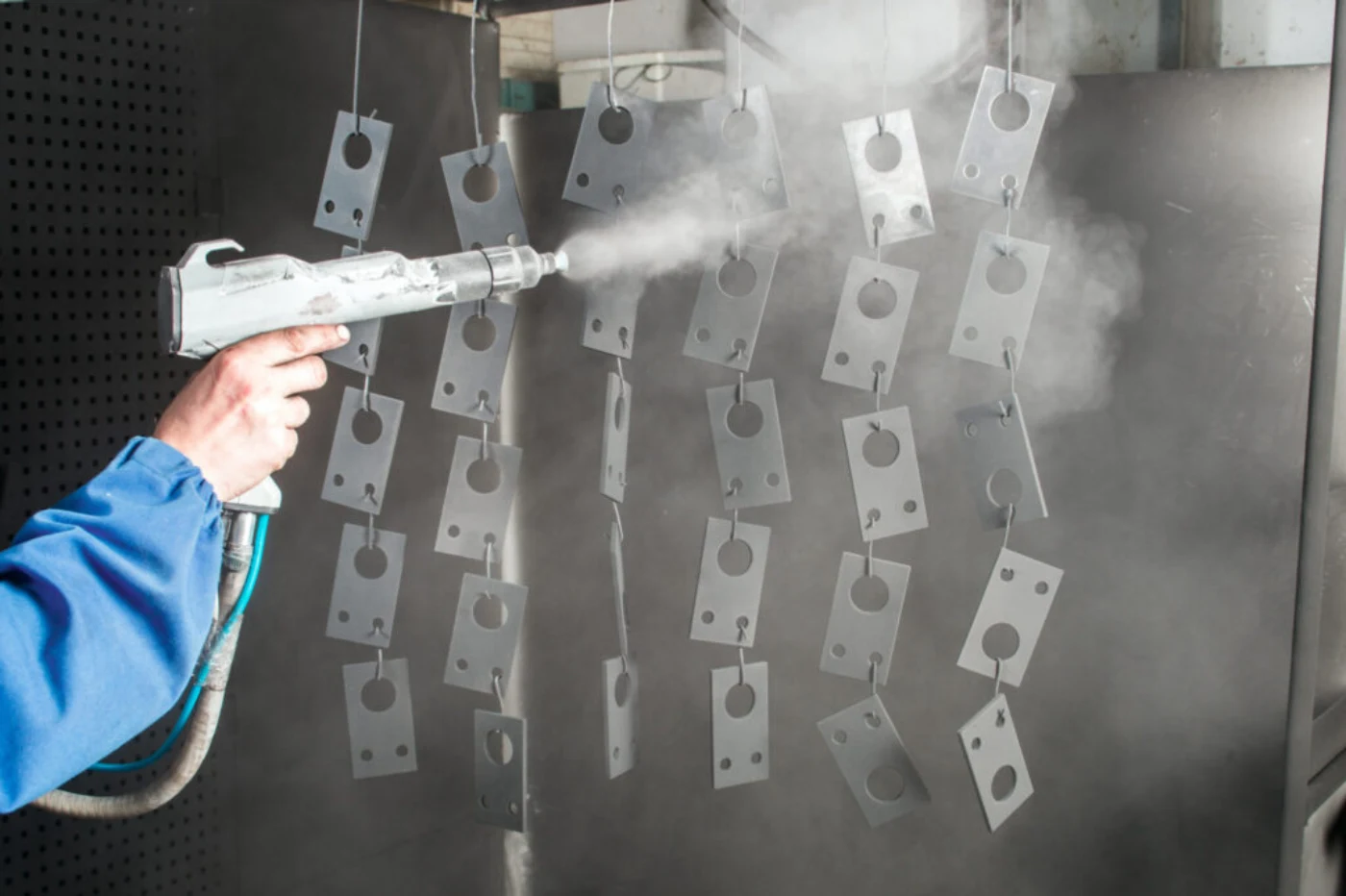
Dry powder, sprayed electrostatically, then baked
The part is charged, dry pigmented powder is sprayed at it and sticks, and the whole thing goes into an oven where the powder melts and flows into a continuous film. There is no solvent, the film is thick and impact resistant, and the colour range is whatever the powder supplier stocks — usually referenced to RAL.
The strengths are real: it survives outdoors, it survives handling, and it hides a multitude of machining marks. The weaknesses follow from the same thickness. It rounds sharp edges, it fills fine engraving, and it cannot hold a tolerance. It also needs somewhere to hang the part, and that hanging point will show.
The oven matters too. Curing runs at a couple of hundred degrees, which is fine for steel and aluminium and not fine for anything with plastic parts, seals or bearings already fitted. Powder coating happens before assembly, not after.
| At a glance | |
|---|---|
| Process type | Electrostatic dry coating, oven cured |
| Materials | Steel and aluminium; not for heat-sensitive assemblies |
| Typical thickness | 60–120 µm per coat |
| Effect on dimensions | Significant — assume the coating fills and grows every unmasked surface |
| Colours | Wide RAL range, plus gloss, satin, matt and textured |
| Detail | Poor at fine engraving and sharp edges |
| Typical parts | Enclosures, frames, machine guards, brackets, outdoor hardware |
When it is the right finish, and when it is not
Choose it when
- —The part lives outdoors or gets knocked about
- —You want a specific colour across a whole assembly
- —A thick, tough film is an advantage rather than a problem
- —The surface finish underneath is not perfect
Choose something else when
- —The part has fits, threads or datum faces that cannot be masked
- —You need fine detail or crisp edges to survive
- —Anything heat-sensitive is already assembled to the part
- —The tolerance band is tighter than the coating thickness
What we need on the drawing
Powder coating is forgiving about the machining and unforgiving about the masking. Three things to settle before the order:
Colour and gloss
A RAL number and a gloss level. If the part sits next to another coated part, send a sample of that part — the same RAL number from two suppliers is not always the same colour in the hand.
Everything that must stay uncoated
Threads, bores, mating faces, earth points, sealing surfaces. On a powder-coated part this list is usually longer than people expect, because the film is thick enough to matter almost everywhere.
Where the part can be hung
Every coated part has a contact point. Tell us which face must be flawless and we will keep the hanging point off it.
Whether anything is assembled
Powder coating is an oven process. Seals, bearings, plastic components and adhesives go on afterwards, not before.
Send the housing and the colour
Send the drawing with the finish you have in mind, or with none at all and a sentence about where the part lives. You get a price, a lead time, and a note on anything in the finish that will fight your tolerances.